
12 AI Skills Worth Learning in 2026 (And Why They Actually Matter)

Writer : Haris Waheed
Full Stack Web Developer & SEO Specialist | Building Fast, Search Optimized Websites for Business Growth.
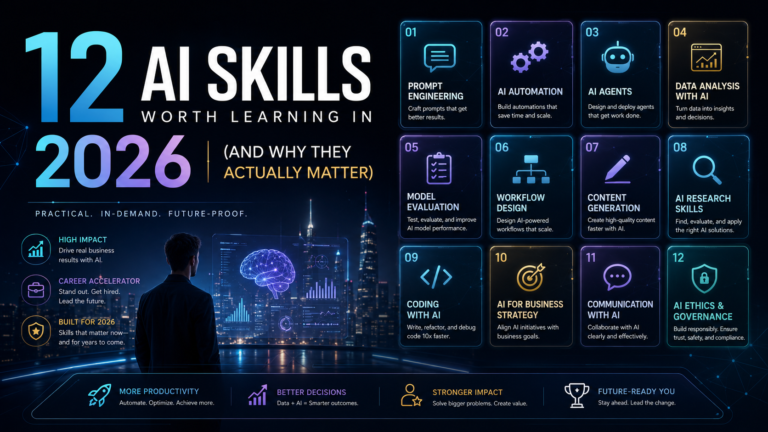
“Learn AI” has turned into one of those phrases people say without really meaning anything by it. It shows up on LinkedIn constantly. You hear it in meetings, at networking events, from career coaches who post three times a day. But almost nobody explains which AI skills are worth your time, why they matter specifically in 2026, and how a person without a computer science background can realistically pick them up.
That’s what this article is for.
At Zynthx Technologies, we work with companies across Dubai, the UAE, the USA, Europe, and the UK. We build AI powered websites, mobile apps, marketing systems, and custom software for a living, which means we see, close up, which AI capabilities genuinely change how a business runs and which ones are just decoration on a slide deck.
Below is our honest, practical rundown of the 12 AI skills we think will shape careers and companies in 2026. Whether you’re trying to future proof your own career or figure out where AI actually fits into your business, this one is for you. If you’d rather learn these skills directly from practitioners, Zynthx Academy runs hands on training programs covering most of what’s on this list
Why This Isn't Optional Anymore
Quick bit of context before the list.
The global AI market is expected to pass $800 billion by 2030. The UAE has built artificial intelligence into its national strategy through programs like the UAE National AI Strategy 2031, and Dubai in particular has positioned itself as one of the most aggressive adopters of AI technology anywhere in the world. Businesses in nearly every sector here are folding intelligent tools into their daily operations.
On the individual side, people with real, demonstrable AI skills are earning noticeably more than their peers who don’t have them. Employers aren’t impressed anymore that someone has used ChatGPT. They want people who can build with these tools, apply them strategically, and produce outcomes that show up on a balance sheet.
The window to get ahead is still open. It’s just closing faster than most people realize.
Here are the 12 skills we think matter most.
1. Prompt Engineering: The Foundation
If you take one thing from this whole article, let it be this: learn prompt engineering.
Prompt engineering is simply the skill of communicating with an AI model in a way that gets you something useful back. It’s the gap between a flat, generic response and an answer that’s specific, sharp, and actually usable.
Think about it this way. A model like Claude is remarkably capable, but it needs decent instructions to show that off. Vague input gets you vague output. A clear, well organized prompt gets you something you can act on immediately.
By 2026, prompt engineering has grown well past typing a one line question into a chat box. People who are genuinely good at it use techniques like chain of thought reasoning, few shot examples, assigning the model a role, and being explicit about the format they want back.
For a business, this skill shows up directly in productivity. Marketing teams use it to produce copy faster. Developers use it to speed up code review. Support teams use it to power chatbots that handle real questions instead of just repeating a FAQ page.
How to build it: Try rephrasing the same request five different ways and watch how the answers change. Study a few prompting frameworks. Practice writing structured instructions. None of this requires a technical background, it’s genuinely something anyone can pick up. Our Uses of AI Training Program covers this from the ground up if you want structured guidance instead of figuring it out alone
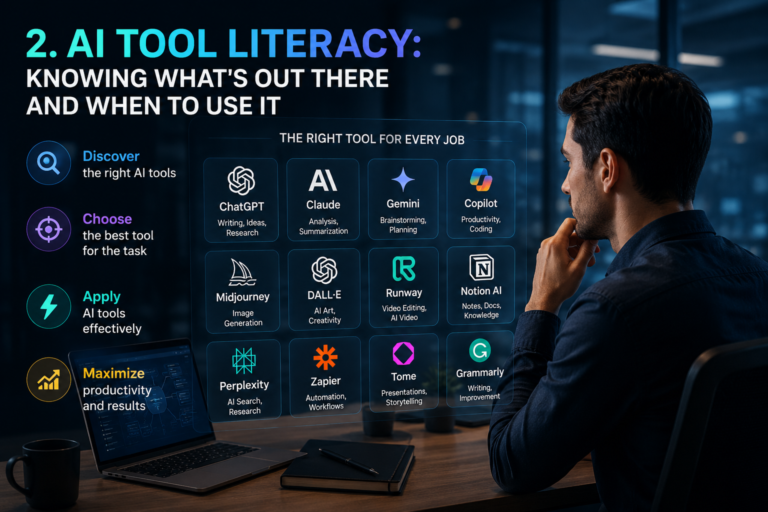
2. AI Tool Literacy: Knowing What's Out There and When to Use It
There are now thousands of AI tools covering every business function imaginable, image generation, video, writing, data analysis, coding, customer service, SEO, social media, you name it.
Tool literacy means being able to navigate that landscape without getting lost in it. It’s knowing which tools are actually good, understanding what each one is and isn’t built for, and choosing the right one for the job in front of you.
This matters more than people expect. We regularly meet businesses that bought AI tools nobody ever opens, or that are using the wrong tool for a task and blaming the technology when the results disappoint them. Nine times out of ten, the problem isn’t the tool, it’s the selection.
In 2026, tool literacy also means knowing how to chain tools together. The strongest AI workflows run several tools in sequence, one for research, one for drafting, one for editing, one for publishing. Building that kind of workflow is a real advantage.
How to build it: Set aside time each week to test something new. Follow a few solid AI newsletters or communities. Build a personal toolkit of what actually works for you, and keep updating it as the landscape shifts. Our blog regularly rounds up what’s actually worth trying, including 5 AI Tools That Feel Illegal to Know About and 20 AI Websites That Feel Illegal to Know About.
3. AI Powered Content Creation: Scaling Without Losing Your Voice
Content still drives visibility in 2026. Companies that consistently publish helpful, relevant, well made content win on search rankings, social reach, and trust. The problem is producing that volume by hand is genuinely exhausting.
AI powered content creation is the skill of using intelligent tools to speed up production without flattening your voice or sacrificing accuracy.
This one takes some judgment. The worst version of it is asking an AI to write a full piece and publishing it untouched. Anyone who’s tried that knows the result reads flat and generic, and it’s obvious. Search engines have gotten noticeably better at spotting low effort AI content, and readers can usually feel it too, even if they can’t quite explain why.
The better version treats AI as a collaborator, not a replacement. A skilled writer uses it to summarize research, sketch outlines, test different angles, break through a stuck point, and speed up editing, while still bringing their own knowledge and voice to the final piece.
For companies competing in a market like Dubai and the wider UAE, this lets you publish genuinely useful content across your website, blog, social channels, and email at a volume that would be impossible working entirely by hand.
How to build it: Practice treating AI writing tools as a drafting partner, not a ghostwriter. Build a sharp editing eye, the ability to spot exactly where AI output needs a human touch. Learn the principles behind Experience, Expertise, Authoritativeness, and Trustworthiness and apply them to everything you publish. Our Digital Marketing Training Program walks through this in detail if you want a structured path.
4. AI for SEO: Ranking in a Search Landscape That's Changed
SEO has always evolved with search engines. In 2026, the biggest shift is that AI is now baked into search itself. Google’s AI driven search features are changing how content gets found, judged, and ranked.
AI for SEO means understanding how these changes work and adjusting your strategy accordingly. That covers using AI tools for keyword research and competitor analysis, and understanding how to shape content for AI driven search results and voice search.
One of the biggest shifts here is the growing weight placed on genuine expertise. Search engines in 2026 are surprisingly good at telling apart content that shows real knowledge from content that just repeats common talking points in different words. The businesses winning in search are the ones investing in content that’s genuinely useful and backed by real experience.
AI tools speed up the technical side enormously, spotting keyword opportunities, analyzing page performance, running technical audits, generating content briefs. But the strategy, the actual expertise, and the editorial judgment that separates strong SEO content from average SEO content still come from people.
At Zynthx Technologies, our digital marketing team uses AI tools as part of a broader SEO approach that puts genuine value for readers alongside technical optimization for search engines. That combination is what produces lasting ranking improvements for our clients across Dubai and beyond.
How to build it: Study how Google’s AI search features actually surface content. Get comfortable with tools like Semrush and Ahrefs. Above all, build real subject matter expertise in your niche, there’s no shortcut for that one. Our SEO Training Program covers this hands on if you’d rather learn it properly than piece it together from blog posts.
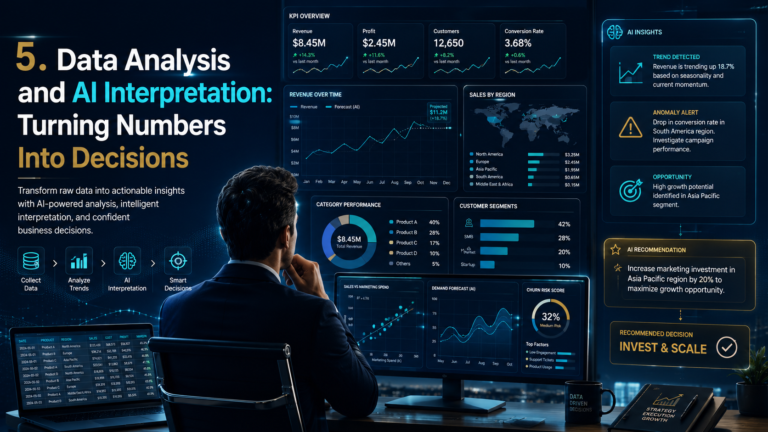
5. Data Analysis and AI Interpretation: Turning Numbers Into Decisions
AI has lowered the barrier to real data analysis dramatically. Work that once needed a dedicated data science team can now be done by ordinary business professionals using AI powered analytics tools, as long as they know how to use those tools well and interpret what comes out.
This skill is about working effectively with AI analytics platforms, asking the right questions of your data, and turning the output into decisions you can actually act on.
It matters enormously right now because businesses are sitting on more data than ever, every website visit, every social interaction, every transaction, every campaign generates it. Companies that can pull real insight out of that data quickly have a genuine edge over those still relying on instinct and guesswork.
The interpretation part is the tricky bit. AI analytics tools can surface patterns and predictions a human analyst might take days to find. They can also surface misleading patterns if you don’t know how to question what you’re looking at. The real skill is treating AI as a powerful lens on your data while keeping enough critical thinking to challenge it when something looks off.
How to build it: Start with something like Google Analytics 4 and its AI powered insights. Try an AI data visualization tool. Make a habit of asking “so what?” every time you look at a number, data only matters once it changes a decision. Our Data Science Training Program is built for exactly this if you want to go deeper.
6. AI Automation and Workflow Design: Doing More With Less
Repetitive manual work is the enemy of productivity. By 2026, there’s very little excuse for knowledge workers to spend big chunks of their day on tasks a well built AI automation could handle faster and more reliably.
This skill is about spotting which processes can be automated, picking the right tools for the job, and connecting them into a workflow that actually holds together.
The range of tasks that can genuinely be automated with AI now is impressive: sorting and drafting emails, scheduling social posts, generating reports, routing customer queries, processing invoices, qualifying leads, repurposing content. In each case, a well designed automation doesn’t just save time, it cuts errors, improves consistency, and frees people up for work that actually needs human judgment.
For businesses across Dubai and the UAE, this is increasingly a competitive requirement rather than a bonus. Companies systematically removing low value manual work from their operations are moving faster and running leaner.
Zynthx Technologies’ AI automation services help businesses across the region find and implement the right automation for their operations, from a single workflow trigger to a complex, multi step process.
How to build it: Map out your weekly tasks and flag the ones that are repetitive and rule based. Try an automation platform. Start with one process, prove it works, then expand. Our Uses of AI Training Program covers practical automation building for non technical teams.
7. AI Powered Customer Experience Design: Building Relationships at Scale
Customer expectations have shifted a lot in the AI era. People expect faster answers, more personal interactions, and generally more helpful experiences from every brand they deal with. The companies meeting that bar in 2026 are mostly doing it through thoughtfully designed AI systems.
This skill covers designing and building AI that improves the customer journey at every touchpoint, from the first website visit to post purchase support. That includes chatbot and conversational design, personalization engines, recommendation systems, and AI powered service workflows.
The key word is design. The technical build matters, but the thinking behind it matters more. A badly designed chatbot that loops customers through irrelevant responses does more damage to a brand than not having one at all. A well designed one handles a huge share of queries instantly, routes the hard ones to the right person, and creates a genuinely good experience at a scale no human team could match alone.
For eCommerce businesses especially, AI powered personalization is a real revenue driver. Recommendation engines that suggest the right product to the right customer at the right moment consistently beat generic product listings on conversion. You can see examples of this kind of work in our portfolio.
How to build it: Study conversational design and customer journey mapping. Try building with a chatbot platform. Learn how personalization engines actually use behavior data to decide what to show someone. Our E-commerce Website Training Program covers this from a practical, build it yourself angle.
8. Machine Learning Fundamentals: Understanding What's Under the Hood
You don’t need to become a machine learning engineer to benefit from understanding how machine learning works at a basic level. In fact, this is one of the most useful things a business professional or marketer can do in 2026.
Why? Because machine learning is the engine behind almost every meaningful AI application in use today. Recommendation systems, fraud detection, predictive analytics, language processing, computer vision, all of it sits on a machine learning foundation. Understanding the basics puts you in a far better position to evaluate AI solutions, ask good questions of technical teams, and make smarter investment decisions.
You don’t need to write the code. But knowing what training data, model bias, overfitting, classification, and regression actually mean will make you a much better collaborator with the people who do write it.
For business leaders in Dubai and the UAE, this kind of literacy is fast becoming a prerequisite for making sound technology decisions. The AI vendor landscape is full of confident claims. Being able to look past the marketing and judge a solution on its actual merits is genuinely valuable.
How to build it: Start with an accessible course that explains machine learning without requiring you to code. Read about real applications in your own industry. Talk to the technical people around you and ask questions until it clicks. Our Machine Learning Training Program is built to take you from zero to genuinely useful.
9. Natural Language Processing Applications: Making Sense of Text at Scale
Natural language processing, or NLP, is the branch of AI concerned with understanding and generating human language. It’s behind everything from the autocomplete on your phone to sentiment analysis tools that scan thousands of reviews in seconds.
By 2026, NLP has become genuinely transformative for any business dealing with large amounts of text, which, realistically, is every business. Reviews, social mentions, support tickets, emails, survey responses, contracts, all of it is unstructured text that traditional analysis struggles with at scale.
Having NLP skills means knowing how to deploy tools that pull real insight from that mess. What are customers actually complaining about most? What’s the overall tone of social conversation around your brand? Which support tickets need urgent attention right now? NLP tools can answer all of that in real time, at a scale no human team could touch.
For businesses in multilingual markets like the UAE, where Arabic and English are both widely used, multilingual NLP is a real operational advantage, being able to analyze customer communication across both languages and pull out consistent insight.
How to build it: Explore NLP tools relevant to your business. Try a sentiment analysis platform. Learn the basic ideas behind how language models actually process text. If you want to go further and build with it yourself, our Python Programming Training Program is a solid starting point.
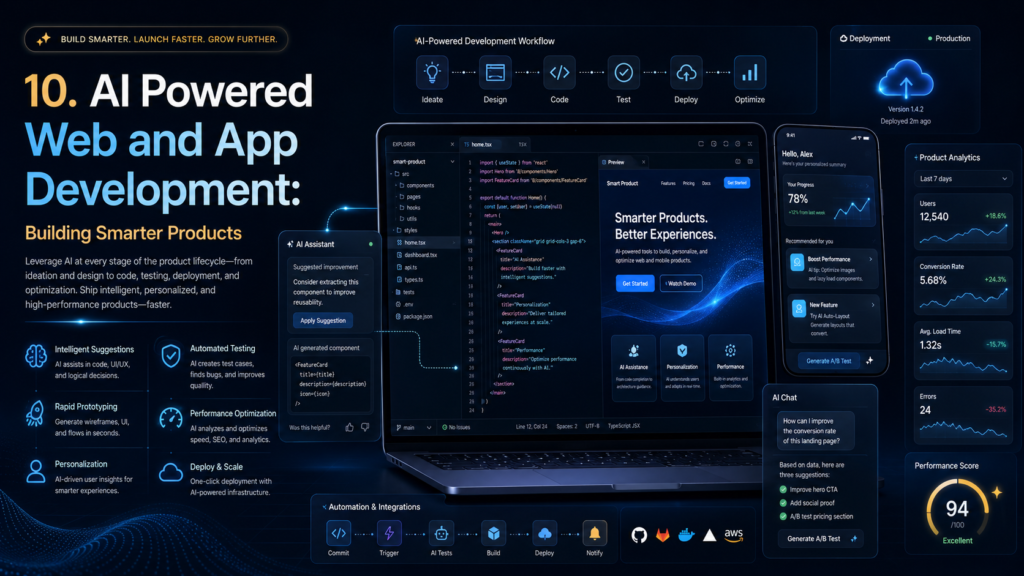
10. AI Powered Web and App Development: Building Smarter Products
How websites and apps get built has changed a lot with AI folded into the development process. AI coding tools aren’t just helping developers move faster in 2026, they’re changing what’s actually possible to build and how quickly.
AI coding assistants can generate whole functions, catch bugs, write test cases, and flag security issues in seconds. AI design tools can produce UI mockups, suggest layout changes, and even turn a design file straight into working code. Teams working this way ship more sophisticated products in less time than ever before.
More importantly, AI is changing what a product can actually do for the user. In 2026, features like intelligent search, personalized recommendations, conversational interfaces, and predictive suggestions are becoming a standard expectation rather than a premium extra.
At Zynthx Technologies, every web development and mobile app development project we deliver includes AI features wherever they genuinely improve the experience, from smart recommendation engines on eCommerce platforms to intelligent search inside enterprise portals. You can browse examples of this kind of work in our portfolio.
How to build it: If you’re a developer, start folding AI coding assistants into your daily workflow and experiment with AI APIs directly. If you’re on the business side, get clear on which AI features would genuinely help your users, and how to brief a development team to build them properly. Our Web Development Training Program and App Development Training Program both cover AI integration as a core part of the curriculum.
11. AI Ethics and Responsible AI: Getting the Governance Right
Most lists like this skip this one entirely, and it’s arguably one of the most important.
As AI gets woven deeper into products, services, and operations, the ethical questions around how it’s used get more consequential. Algorithmic bias, data privacy, transparency, accountability, and the potential for AI systems to cause real harm are all serious concerns businesses need to take seriously.
This skill is about understanding those risks, designing systems that reduce them, and running AI powered products responsibly and in line with the relevant rules.
In markets like the UAE, Europe, and the UK, where Zynthx Technologies serves clients, the regulatory picture around AI and data is moving fast. The UAE’s PDPL, Europe’s GDPR, and emerging AI specific regulation all shape how businesses can collect and use data to power AI systems. Building compliance in from the start is far easier than trying to retrofit it later.
Beyond compliance, there’s a real advantage in being a business customers and partners trust to use AI responsibly. As AI shows up more in everyday life, public awareness of the risks is growing too. Companies that can show a genuine commitment to responsible AI practice will stand out.
How to build it: Learn the core principles of responsible AI, fairness, transparency, accountability, privacy. Get familiar with the data protection rules relevant to your markets. Follow the policy conversations happening around AI governance in your region. Our Ethical Hacking Training Program is a useful adjacent skill here too, since security and responsible AI practice overlap more than people expect. For a look at how fast this space is moving, see our post on what AI becomes after regulation shifts.
12. LLMOps and AI Model Management: The Advanced Frontier
This is the most technical skill on the list, and the one that commands the highest premium for people who genuinely get good at it.
LLMOps, short for Large Language Model Operations, is the discipline of deploying, managing, monitoring, and continuously improving large language models once they’re live in production. It’s the operational backbone behind enterprise AI systems, the part that keeps them running reliably, safely, and cost effectively at scale.
If you work in technology, data engineering, or enterprise software, this is a skill worth investing serious time in. Demand for people who can manage AI model lifecycles, build solid evaluation frameworks, run fine tuning pipelines, and monitor performance in production is growing faster than the supply of people who can actually do it.
For businesses deploying AI at scale, LLMOps is what separates a demo that looked great from a system that reliably serves thousands of real users. Getting it right takes a mix of software engineering discipline, data management expertise, and a genuine understanding of how large language models behave in practice.
At Zynthx Technologies, our custom software development team works with enterprise clients to build AI infrastructure designed for long term reliability, security, and performance, not just an impressive first demo.
How to build it: If you have a technical background, start by studying the core pieces of an LLMOps pipeline, data management, evaluation, deployment infrastructure, monitoring, and fine tuning. Explore open source frameworks and cloud AI platforms. Build hands on experience with real projects. Our Python Programming Training Program is a solid foundation if you’re starting from scratch, and our post on Claude Sonnet 5 breaking agent loops is a good real world look at why production model management is harder than it looks.
How These 12 Skills Connect to Business Growth
Reading through all this, you might be wondering how it ties back to actually running a business. The connection is more direct than you’d think.
Every skill on this list shows up somewhere in how businesses compete, serve customers, and make money in 2026. Prompt engineering and tool literacy make teams more productive. AI powered content and SEO skills drive organic growth and visibility. Data analysis leads to sharper decisions. Automation cuts costs and improves consistency. Customer experience design drives loyalty and repeat business. The more advanced skills, machine learning fundamentals, NLP, AI powered development, responsible AI, and LLMOps, are what let a business actually build differentiated AI powered products rather than just use someone else’s.
The companies pulling ahead of their competitors across Dubai and the UAE in 2026 aren’t winning because they have access to better technology than everyone else. They’re winning because they’ve invested in the skills to use that technology well.
Where Zynthx Technologies Fits In
We’re not writing this from the sidelines. We’re building this stuff daily, and we help our clients do the same.
Zynthx Technologies is a Dubai based AI powered digital agency delivering web development, mobile app development, digital marketing, eCommerce solutions, custom software development, and AI automation for organizations across the UAE, USA, Europe, and the UK.
Every service we deliver is shaped by an actual understanding of AI and where it creates real value. We’re not selling it as a magic fix for every problem. We apply it thoughtfully and responsibly to help clients grow faster, serve customers better, and run more efficiently.
If you’re a business owner wondering how any of this applies to your situation, we’d genuinely like to talk. Book a free consultation with our team, or head straight to start a project if you already know what you need. You can also read more about us, and if you’re looking to build a career in this space rather than hire for it, check out Zynthx Careers.
Final Thought: Start Before You Feel Ready
Here’s the most useful thing we can tell you about building AI skills in 2026.
Don’t wait until you feel ready. Don’t wait for the perfect course, the perfect moment, or full certainty about where AI is heading, because that certainty isn’t coming. The people and businesses pulling ahead right now started experimenting and learning before they had all the answers.
Start with prompt engineering. It costs nothing and pays off immediately. Build outward from there. Stay curious. Be willing to get things wrong and learn from it. Talk to people further along than you and ask what they wish they’d known earlier.
The AI shift isn’t coming, it’s already here. The real question is whether you’ll be ahead of it or behind it once its full impact is impossible to ignore.
At Zynthx Technologies, we’re committed to helping businesses across Dubai and beyond not just understand this shift but genuinely thrive in it. Explore our services and get in touch if you’d like to talk about what that looks like for you. And if you want to keep up with where AI is heading next, our blog is updated regularly with practical breakdowns, not hype.
Let's Start a Project
Share your idea with Zynthx and our team will help you plan the next clear step.
Writer : Haris Waheed
Full Stack Web Developer & SEO Specialist | Building Fast, Search Optimized Websites for Business Growth.


