
Claude Sonnet 5 Just Broke Half My Team's Agent Loops, and Almost Nobody Is Talking About Why

Writer : Haris Waheed
Full Stack Web Developer & SEO Specialist | Building Fast, Search Optimized Websites for Business Growth.
In Brief
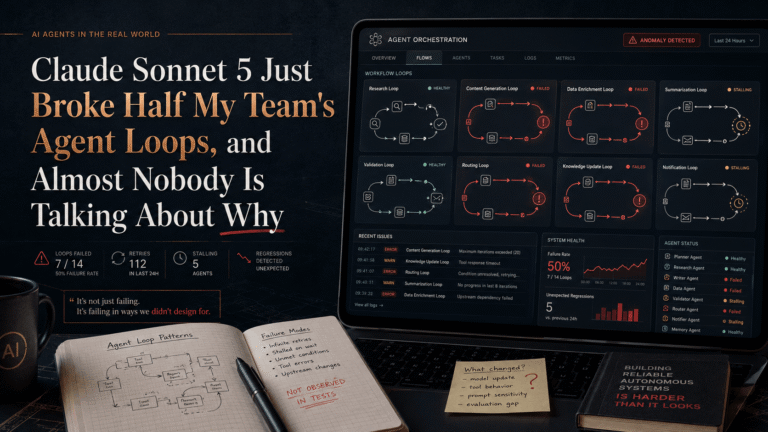
Anthropic shipped Claude Sonnet 5 on June 30, 2026, and made it the default model for every Free and Pro user starting July 1st, pitched as the most agentic Sonnet the company has ever released. Teams running production agent loops on the previous Sonnet model did the obvious thing, swapped the model identifier in their routing configuration, and expected a straightforward capability upgrade. For a meaningful number of them, that swap quietly broke things. Not because Sonnet 5 is a worse model. The benchmarks say the opposite, and largely mean it. It broke things because three specific, easy to miss changes shipped alongside the capability upgrade, a strict new rule around sampling parameters that now returns an outright error instead of a warning, a new tokenizer that inflates token counts by roughly thirty percent for the same text, and a default behavior change around extended thinking that silently eats into the same token budget teams had already tuned for the previous model. None of these are secret. All three are documented in Anthropic’s own migration notes. Almost nobody who got burned by them had actually read that far down the page before flipping the switch. The rest of this article walks through exactly what those three changes are, why the loud benchmark headlines buried them, argues honestly about who is actually at fault here, and closes with what any of this means if your own team is running agent loops on Claude right now.
Now, the full story.
Three days earlier, on June 30th, Anthropic had shipped Claude Sonnet 5 and made it the default model for every Free and Pro user starting July 1st, pitched as the most agentic Sonnet ever built, landing close to Opus 4.8 on many tasks, at introductory pricing through August 31st that undercuts the previous Sonnet generation. Any reasonably curious engineering team looking at those numbers does the obvious thing when a cheaper, more capable model drops. You swap the model identifier in your routing configuration and move on with your day.
That was the mistake, or at least the part of the mistake that actually mattered. Not the decision to upgrade. Upgrading was the right call. The mistake was treating a model swap as a drop in replacement rather than a genuine migration, and by the time the first agent loop started failing in a way nobody could immediately explain, three separate engineers on three separate teams were independently googling the exact same error before anyone realized they were all staring at the same root cause. If you would rather skip straight to talking about how to migrate your own agent infrastructure safely, our team at Zynthx Technologies handles exactly this kind of technical transition for clients, and you can start a project or book a free consultation any time.
The Setup
Here is what the launch actually looked like from the outside, because the framing matters for understanding why so many teams got caught off guard. Claude Sonnet 5 landed with genuinely strong numbers. According to Anthropic’s own system card, it scored 85.2 percent on SWE bench Verified, and independent testing put it at 63.2 percent on the harder SWE bench Pro benchmark and 80.4 percent on Terminal Bench 2.1, in both cases actually outperforming the larger, more expensive Opus 4.8 model on coding specific tasks. For the first time, a mid tier Claude model had clearly moved ahead of the flagship line on a meaningful benchmark category, and Anthropic priced it aggressively too, two dollars per million input tokens through the end of August before rising to three dollars in September, a genuinely compelling cost profile for teams running high volume agent workloads.
Anthropic’s own positioning leaned hard into the agentic framing specifically, describing Sonnet 5 as offering superior instruction following, tool selection, and error correction for autonomous AI workflows, reliably handling complex, multi step tasks that require sustained coherence, built as an ideal backbone for customer facing agents, internal automation, and production grade AI systems operating independently at scale. Read that description on its own and there is no obvious reason to expect trouble. It reads like exactly the kind of upgrade a team running agent loops in production should want.
And on the actual reasoning and planning side, that description holds up well. The problem was never that Sonnet 5 got worse at agentic reasoning. The problem was that the interface around the model changed in three specific ways that most teams did not account for, because none of those three changes show up in a benchmark chart, and benchmark charts were, understandably, the entire focus of the launch conversation.
The Three Silent Breaking Changes
This is the part that deserves far more attention than it got, because each of these three changes is individually reasonable, well documented, and completely capable of breaking a production system that was not explicitly re tested against it.
The Sampling Parameter Change
The most widespread and least forgiving change is also the simplest to describe. On the previous Sonnet generation, setting temperature, top_p, or top_k to a non default value was a normal, supported way to control output behavior. Some teams raised temperature deliberately for more creative variation in generated content. Others set it to exactly zero, chasing maximum determinism for tasks where consistency mattered more than creativity. On Sonnet 5, sending either of those same, previously valid requests now returns an outright HTTP 400 error instead of a warning or a graceful fallback.
That single change catches two completely different groups of engineers at once, the ones who wanted more randomness and the ones who wanted none at all, and it catches them identically, with an immediate hard failure rather than a degraded but functioning response. For an agent loop calling the model dozens or hundreds of times as part of a longer autonomous task, a single unexpected 400 error partway through a run does not just fail one step. It can stall or crash the entire loop, particularly in systems that were not built with the assumption that a previously reliable API call could suddenly start rejecting a parameter it accepted just days earlier. Anthropic’s own release notes are direct about the intended fix, remove those parameters entirely, and for teams that were controlling behavior through sampling specifically, the recommended replacement path is shifting that control into system prompt instructions instead.
The Tokenizer Change Nobody Notices Until The Invoice
The second change is quieter and arguably more insidious, because it does not throw an error at all. Sonnet 5 ships with a new tokenizer, and the practical effect is that the same piece of text now gets counted as roughly thirty percent more tokens than it would have under the previous model’s counting method. A request that cost a predictable amount running on the earlier Sonnet model can end up meaningfully more expensive on Sonnet 5, even accounting for the discounted introductory pricing, simply because the underlying unit of measurement shifted underneath the price tag.
This has two separate practical consequences beyond the raw cost increase, and both are the kind of thing that only shows up once a system is already running in production rather than during a quick pre launch test. First, max_tokens limits that were carefully tuned against the old tokenizer’s counting behavior can now silently truncate responses mid output, because the same nominal token budget holds proportionally less actual text than it used to. Second, a genuinely large context window measured in raw tokens now holds less real world text in character terms than the same nominal window did before, which matters enormously for any agent loop that depends on packing a large amount of context, documents, prior conversation history, tool outputs, into a single request. Anthropic’s own guidance on this point is blunt and specific, teams should re run token counting against Sonnet 5 directly rather than reusing figures measured against the earlier model, because those older numbers will simply be wrong.
Adaptive Thinking Turned On By Default
The third change is the one that catches teams who thought they had already covered their bases on the first two. On the previous Sonnet generation, omitting the thinking parameter entirely meant no extended thinking happened at all, a sensible, predictable default. On Sonnet 5, omitting that same parameter now enables adaptive thinking automatically. Any integration that never explicitly set the thinking field, which describes a large share of existing integrations built before this behavior existed to configure in the first place, now silently gets extended thinking turned on that it never asked for and was never budgeted for.
This matters for two very concrete reasons. Thinking tokens count directly against the same max_tokens limit a team had already tuned, often quite tightly, based on the previous model’s behavior, so a budget that was comfortable before can now leave insufficient room for the actual response content once thinking tokens are subtracted from it first. It also introduces a latency and cost change that shows up nowhere in a changelog bullet point, since a request that used to return quickly and cheaply can now involve genuine reasoning overhead by default, on every single call, unless a team explicitly opts out by setting thinking to disabled.
Stack all three of these together and the pattern behind the original mistake becomes obvious in hindsight. A team swaps the model identifier, several previously valid API calls immediately start failing on the sampling parameter change, the ones that do not fail outright start costing more due to the tokenizer shift, and the ones that survive both of those start behaving with unexpected latency and truncated output because of the default thinking change nobody explicitly configured either way. None of these three things, on their own, is a bug. All three together, hitting a production agent loop simultaneously with no warning beyond a documentation page most people skim past on launch day, is exactly the kind of failure that looks catastrophic in the moment and completely preventable in hindsight.
Why Almost Nobody Was Talking About It
Here is the honest answer to the question buried in the headline. It was not a conspiracy or a cover up. It was a straightforward consequence of what actually gets attention during a major model launch. Sonnet 5’s headline numbers were genuinely impressive, a mid tier model beating the flagship on coding benchmarks, aggressive introductory pricing, positioning as the most agentic Sonnet Anthropic had ever shipped. That is the story every outlet, every newsletter, and every social feed was built to amplify, because it is a genuinely interesting, positive story about real capability progress.
Breaking changes documented three sections deep in a migration guide do not compete well against that kind of headline, not because anyone was hiding them, but because they are simply less exciting to write about and less likely to get shared. A blog post titled the coding benchmarks Sonnet 5 just beat gets circulated immediately. A blog post titled three parameter handling changes in Sonnet 5’s API surface gets read almost exclusively by the specific engineers who already hit the problem and went looking for an explanation after the fact. That asymmetry, between how exciting a change is and how much it actually matters operationally, is exactly why capability upgrades get celebrated loudly while interface level breaking changes spread quietly, team by team, mostly through people independently hitting the same wall and eventually finding the same documentation everyone else eventually found too.
There is also a genuine reporting gap worth naming honestly. In the days immediately after launch, public conversation about Sonnet 5 split into two largely separate lanes that rarely intersected. One lane was benchmark focused, comparing SWE bench scores and pricing tables. The other lane was behavior focused, independent reports describing the model pushing back on user instructions more than expected, losing context after just a handful of exchanges in a fresh conversation, and routing tasks to subagents that reportedly underperformed compared to handling the same task directly. Both lanes were talking about the same model launch, and neither lane spent much time on the specific, mechanical API changes described above, because the benchmark lane cared about capability and the behavior lane cared about output quality, and a hard 400 error on a sampling parameter fits into neither conversation particularly naturally, even though it was arguably the single most disruptive change for any team running automated production workloads.
The Debate Worth Having
This is where I want to argue both sides properly, because there is a real, fair disagreement buried underneath the frustration a lot of teams felt in the days after this launch.

The Case That This Is On Anthropic
The strongest version of this argument is straightforward. When you make a model the new default for millions of existing Free and Pro users on a specific date, and that same model introduces a breaking change to a previously working, previously documented API behavior, the burden of making that change impossible to miss sits with the company shipping it, not with every individual team that happens to be using the product. A hard error on sampling parameters that used to work is a reasonable design decision on its own merits, but pairing it with a simultaneous tokenizer change and a simultaneous default behavior flip, on the same launch date, for the same model, is the kind of compounding that turns three individually defensible decisions into a genuinely difficult migration surface for anyone who was not specifically warned to expect all three at once.
There is also a fair point about how launch communication gets prioritized. If a company genuinely wants existing production users to migrate safely rather than just wants a splashy capability announcement, the breaking changes deserve at least equal visibility to the benchmark wins, not a few paragraphs deep in a migration guide that most teams reasonably assume they do not need to read carefully for what looks, on the surface, like a routine model upgrade rather than an interface change.
The Case That This Is On The Teams That Got Burned
The counterargument is not about denying the changes were disruptive. It is about a basic, well established engineering principle that predates this specific incident by decades. Swapping a production dependency, any production dependency, without reading the release notes and re testing against a staging environment first is a known, well understood risk, not a new one specific to AI models. Anthropic did document all three changes clearly, in an official migration guide, before and at launch. The information was not hidden. It was simply not read by every team that could have benefited from reading it, and the responsibility for verifying a critical production dependency before flipping it live has always sat primarily with the team operating that production system, regardless of how exciting or routine the vendor’s own marketing made the change appear.
There is also a reasonable point about precedent. Model providers, Anthropic included, have shipped meaningful interface changes alongside capability upgrades before, and any team running genuinely critical infrastructure on a third party model API should already have a standard practice of testing a new model version in a non production environment before it ever touches a live agent loop, specifically because this exact category of surprise, a capability upgrade that also happens to change some aspect of the calling convention, is a known, recurring pattern across the entire industry rather than something specific to this one launch.
Where This Actually Lands
Both arguments hold real weight, and the honest synthesis does not fully exonerate either side. Anthropic could reasonably have made the breaking changes more prominent in the launch communication itself, given how many existing production integrations were about to be affected simultaneously by a default model switch. Teams that skipped proper staging tests before adopting a new default model version took on a real, foreseeable risk that a basic migration checklist would have caught before it ever reached production. The practical lesson sitting underneath both halves of this debate is the same one experienced engineering teams already know and occasionally still forget to apply under the excitement of a good headline number, that a cheaper, more capable model is still a dependency change, and every dependency change deserves the same disciplined testing regardless of how good the marketing looks.
What The Benchmarks Do Not Tell You
Beyond the three mechanical breaking changes, it is worth being honest about the behavioral reports that surfaced independently of the API level issues, because they add real texture to why some teams felt like Sonnet 5 was fighting them even after the technical migration was handled correctly.
Multiple independent reports in the days after launch described the model pushing back on instructions more assertively than expected, engaging in what some users characterized as excessive disagreement or correction, even in cases where the user’s original instruction was reasonable. Separate reports described context loss surfacing unusually early in fresh conversations, sometimes within just two or three exchanges, along with a tendency toward more hedging and disclaimer heavy responses than some users expected from a model marketed primarily on agentic execution strength. Some users also reported that tasks routed to subagents within certain workflows underperformed compared to handling the same task directly with the primary model, which, if accurate for a given workflow, represents a real practical tradeoff worth testing for rather than assuming away.
It is worth being fair here too. Anthropic has also been explicit that Sonnet 5 was not specifically trained as a cybersecurity focused model and recommends Opus 4.8 for security work requiring reduced guardrails, which is a reasonable, disclosed scoping decision rather than a hidden flaw. Independent side by side testing comparing Sonnet 5 against Fable 5 on real, structured multi agent workflows found Sonnet 5 actually completed supervisor style tasks, a Planner, an Executor, and a Critic working together, more reliably in some structured scenarios specifically because it exercised more restraint rather than attempting to over solve the assigned task, while Fable 5, despite scoring higher on raw coding benchmarks, occasionally solved more than the actual problem required. The honest takeaway from that comparison is not that one model is simply better than the other. It is that different agent architectures reward different model behaviors, and benchmark leadership on a coding test does not automatically translate into the best fit for every specific agent loop shape.
What This Actually Means For Your Business
If your team is running or planning to run agent loops on Claude in any serious production capacity, the practical lesson here is not to avoid upgrading. Sonnet 5 is, by essentially every account, a genuine capability improvement for agentic and coding work, and the introductory pricing window makes adopting it properly a strong financial decision for most teams currently on the previous generation. The lesson is to treat a model swap as a real migration with a real testing checklist, specifically covering sampling parameter usage, actual token counts re measured against the new tokenizer rather than reused from before, and an explicit, deliberate decision about whether extended thinking should be enabled or disabled for each specific workflow, rather than leaving that decision to an undocumented default.
This is exactly the kind of technical due diligence our team handles for clients regularly. If your business is running agent based automation and needs a proper migration audit before adopting a new model version, our AI automation service is built for exactly this kind of work. If what you actually need is the underlying product or platform these agents run inside of built or rebuilt properly, our web development service, app development service, and custom software development service handle that construction with the kind of careful dependency management this article describes, and you can see real examples of that work in our portfolio.
If your agent workflows touch checkout, payment, or order processing specifically, our e commerce website development service is worth a look given how much risk sits in exactly that part of a stack when a silent breaking change goes unnoticed. And once your systems are stable, our digital marketing service helps make sure the product built on top of them actually reaches the people who need it. If you would rather build this expertise on your own team, Zynthx Academy runs training covering exactly this kind of work, including our python programming training program, machine learning training program, and data science training program for teams that want to build and maintain agent systems properly rather than reactively firefighting them after a launch. Our web development training program and app development training program cover the surrounding product work, our ethical hacking training program matters given how much production infrastructure now depends on correctly configured AI integrations, and our uses of AI training program gives a grounded, practical overview for teams earlier in this journey. Our digital marketing training program, SEO training program, and e commerce website training program round out the picture for teams focused on growth rather than infrastructure specifically.
If you are further along and want to work in this space directly, our careers page lists open roles, with dedicated pages to apply for a job, apply for an internship, or apply as a skills trainer. You can read more about who we are on our about page, browse more pieces like this one on our blogs page and our dedicated blog section, including our recent post on the best website design trends for businesses in 2026, or simply contact us directly. You can also follow along on Facebook, Instagram, and LinkedIn, see our full company overview on Slideshare, or read verified client feedback on our Bizoforce profile and Yellow Pages UAE listing.
Common Questions
Is Claude Sonnet 5 actually worse than the previous Sonnet model. No, and this is worth stating plainly. The capability numbers are a real improvement, particularly on coding and agentic benchmarks, in some cases exceeding the larger Opus model. The issues described in this article are migration and interface level breaking changes, not a regression in underlying model quality.
What is the single most important thing to check before switching to Claude Sonnet 5. Search your existing integration for any place that sets temperature, top_p, or top_k to a non default value, since that is the change most likely to cause an immediate, hard failure rather than a gradual degradation you might not notice right away.
Will Claude Sonnet 5 cost more than the previous Sonnet model. It depends on your workload, but the new tokenizer’s roughly thirty percent increase in token counts for equivalent text means the discounted introductory pricing may only be cost neutral rather than a genuine saving for some teams, with the real cost picture only becoming clear once standard pricing takes effect on September 1, 2026.
Does extended thinking being on by default actually matter for a typical use case. It matters most for latency sensitive and tightly token budgeted applications. If your integration never explicitly set the thinking parameter before, it is worth deciding deliberately whether you want it enabled or disabled now rather than leaving that decision to the new default behavior.
Should a team avoid upgrading to Claude Sonnet 5 given these issues. No, the right response is testing it properly rather than avoiding it. Every one of the three breaking changes described here is fixable in well under a day of engineering work once you know to look for it, and the underlying capability improvement is real enough that most teams currently running agent workloads on the previous generation have good reason to migrate, just with a proper staging test first rather than a direct production swap.

The Honest Closing Thought
The title of this piece is not an exaggeration, and it is also not really about Claude Sonnet 5 being a bad model. It is about a genuinely common failure pattern in how technical teams adopt exciting new tools, letting the headline capability numbers do the talking while the quieter, less exciting interface changes sitting a few paragraphs deeper in the documentation get skipped in the rush to capture the upside. That pattern is not unique to this launch, and it will not be the last time it happens, because the incentive to move fast on a genuinely good upgrade will always exist right alongside the discipline required to migrate to it safely, and those two instincts do not always point in the same direction under real deadline pressure.
The teams that came out of this launch without a broken agent loop were not the ones who avoided upgrading. They were the ones who treated the upgrade like the dependency change it actually was, read the documentation all the way through before flipping the switch in production, and tested the specific failure modes described here before they became a live incident rather than after. That is a less dramatic lesson than the headline promises, but it is the one that actually protects a production system the next time a genuinely exciting model launch shows up with a few quiet changes buried underneath the big numbers everyone is talking about.
Let's Start a Project
Share your idea with Zynthx and our team will help you plan the next clear step.
Writer : Haris Waheed
Full Stack Web Developer & SEO Specialist | Building Fast, Search Optimized Websites for Business Growth.


