
20 AI Websites That Feel Illegal to Know About

Writer : Haris Waheed
Full Stack Web Developer & SEO Specialist | Building Fast, Search Optimized Websites for Business Growth.

In Brief
There is a growing genre of internet content built entirely around one premise, that a handful of ai websites are so powerful relative to how little effort they require that using them almost feels like cheating. None of them are actually illegal. All of them are public, legitimate, and available to anyone with an internet connection. What makes them feel illegal is simply the size of the gap between what they can do and how obvious their existence still is not to most people. This article walks through twenty genuinely useful ai websites, grouped by category so the list is actually usable rather than just a wall of names, followed by an honest debate about whether tools like this create an unfair advantage or simply level a playing field that used to favor whoever had the biggest budget, and what any of this actually means if you run a business.
Now, the full list.
There is a specific feeling that happens the first time you use a genuinely well built ai tool for something that used to take real effort. You upload a rough audio recording and get a clean, edited transcript back in under a minute. You describe a presentation and watch twenty slides appear with a coherent argument already built into them. You paste in a messy research question and get an actual, cited answer instead of ten blue links you now have to read yourself. That feeling, somewhere between delight and mild suspicion that you are getting away with something, is exactly why this genre of internet writing keeps appearing under slightly different titles every few months. The premise never really changes. Certain ai websites just feel disproportionately powerful for how little most people know about them.
I want to take that premise seriously and build an actual, well organized list around it, rather than just repeating the same eight or nine tools every article in this genre tends to circle back to. So here are twenty genuinely useful ai websites, grouped into six categories that actually make sense together, followed by a proper debate about whether the entire premise is even a good thing, and a practical section on what this means if you are running a real business rather than just personally curious. If you want to skip straight to talking about how any of this could actually work for your own business, our team at Zynthx Technologies works with these categories of tools daily, and you can start a project or book a free consultation any time.
Why These Tools Feel Illegal In The First Place
Before the list itself, it is worth actually answering the question the title raises rather than just using it as a hook. These tools do not feel illegal because they break any law. They feel illegal because of a specific, repeatable pattern, they collapse a task that used to require real skill, real time, or real money into something that takes a sentence and a few seconds. A skill that used to take years to develop, editing video, designing a slide deck, researching a technical topic properly, writing production ready code, suddenly becomes accessible to someone with no formal training in any of it. That gap, between effort required and result produced, is the entire feeling this genre of content is describing, and it is worth naming honestly rather than treating it as some kind of secret loophole.
It is also worth noticing why this particular framing, feels illegal, spread as widely as it did across dozens of independently written articles rather than staying confined to a single viral post. Part of the appeal is genuinely psychological. Discovering something powerful that most people around you do not yet know about taps into a very old, very human feeling, the sense of having found an edge before everyone else catches up. That feeling is not unique to AI tools specifically. It shows up whenever a genuinely useful piece of knowledge or technology spreads unevenly, and it tends to fade the moment that knowledge becomes common enough that the advantage disappears simply because everyone has access to it. The interesting question is not really whether these specific tools stay obscure. History suggests they will not. The interesting question is what replaces them once they become common knowledge, and the honest answer is usually the next tool solving the next problem nobody has properly automated yet.
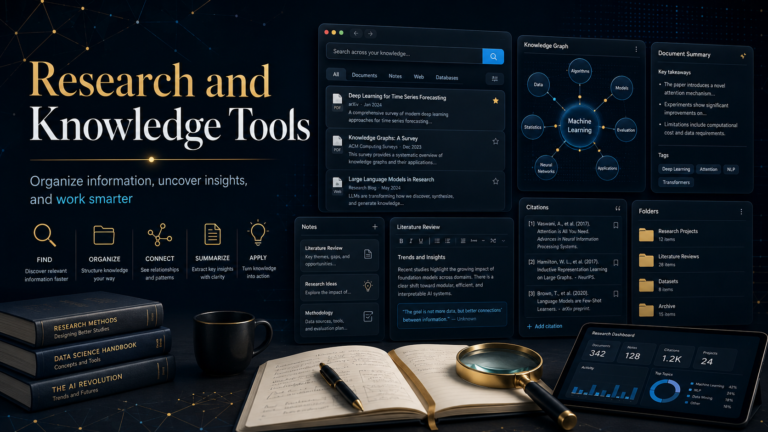
Research and Knowledge Tools
The first category covers tools that fundamentally change how people find and process information, arguably the single biggest shift in this entire space.
Perplexity works like a search engine that actually read the results before handing them to you. Instead of a list of links, it gives a direct, cited answer pulled from real, current sources, with every claim traceable back to where it came from. For anyone who spends real time researching topics for work, the honest comparison is going from skimming ten articles yourself to having a well read assistant summarize them accurately with receipts attached.
NotebookLM takes a different approach, letting you upload your own documents, whether that is a stack of PDFs, meeting notes, or research papers, and then ask questions that get answered strictly from that material rather than the open internet. This matters enormously for anyone doing focused research on a narrow topic where general web answers are too broad to be useful.
Consensus searches specifically across peer reviewed scientific literature rather than the general web, summarizing what actual published research says about a question rather than what a blog post claims research says. For anyone who has ever tried to verify a health or science claim manually, the time this saves is substantial.
Writing and Content Tools
The second category covers tools built around producing and refining written material, an area that has changed more visibly than almost any other over the past two years.
Claude and ChatGPT are the two names most people already know, but it is worth being specific about what they are actually good for beyond generic chatting. Both can draft, restructure, and refine long form writing, explain complex topics at whatever level of detail you need, and work through a problem conversationally rather than requiring a perfectly phrased question upfront.
Grammarly has quietly evolved well past its original spell check roots into a full writing assistant that adjusts tone, catches unclear phrasing, and flags sentences that technically work but do not actually communicate what the writer meant.
Sudowrite is built specifically for fiction writers, helping with everything from brainstorming plot directions to rewriting a scene in a different tone, a genuinely useful tool for creative writers rather than a generic business writing assistant.
Design and Visual Tools
The third category covers tools that make genuinely competent visual design accessible without design training, which is exactly where this genre’s central premise feels most obviously true.
Canva Magic Studio turns a rough description into a finished visual, a social media graphic, a simple logo concept, a marketing image, without requiring any actual design skill from the person using it. For a small business owner who cannot justify a full time designer, this closes a gap that used to require either a real budget or real personal skill.
Ideogram specializes in generating images that actually include readable, correctly spelled text within the image itself, a problem that used to make AI generated graphics with any lettering nearly unusable for real marketing purposes.
ClipDrop offers a full suite of quick image editing tools, removing backgrounds, upscaling low resolution photos, and cleaning up product images, useful for anyone running an online store who needs professional looking product photography without a professional photography budget.

Video and Audio Tools
The fourth category covers tools that have arguably changed content creation more visibly than any other category, since video and audio used to require the most specialized equipment and skill of anything on this list.
HeyGen creates fully scripted talking avatar videos from text alone, letting a business produce training videos, product explainers, or social content without ever needing to film an actual person on camera.
Descript treats audio and video editing like editing a text document, letting you cut a sentence out of a recorded video simply by deleting the corresponding text, which removes the single most tedious part of video editing entirely.
ElevenLabs produces text to speech audio realistic enough that most listeners genuinely cannot tell it apart from a real human voice, useful for narration, audiobooks, and voiceover work at a fraction of traditional studio cost.
OpusClip automatically finds the most engaging moments in a long video and turns them into short, social ready clips, a task that used to require a human editor scrubbing through hours of footage manually.
Presentation Tools
The fifth category is smaller but genuinely transformative for anyone who has ever lost an afternoon to formatting slides instead of thinking about the actual content.
Gamma turns a rough outline or even a single prompt into a complete, properly designed presentation, handling layout, structure, and visual consistency automatically so the person can focus entirely on the substance of what they are presenting.
Tome takes a similar idea in a slightly different direction, building interactive, story style presentations that feel more like a guided narrative than a static slide deck, particularly useful for pitches and product walkthroughs.
Coding and Automation Tools
The sixth category covers tools aimed at developers and technically minded business owners, and this is where the capability jump has been most dramatic over the past year specifically.
Claude Code goes well beyond simple code completion, capable of planning an entire coding task, executing it across multiple files, running tests, and increasingly working through long, complex projects with minimal supervision, a genuine shift in how much a single developer or a small team can accomplish.
Cursor takes a more editor centered approach, embedding AI deeply into a familiar coding environment so a developer gets fast, contextual suggestions without leaving their usual workflow.
Zapier AI and similar automation platforms let a non technical business owner connect different tools and services together into an automated workflow using plain language instructions, rather than requiring custom development work for every integration.
Business and Productivity Tools
The final category covers tools built for the everyday operational side of running a business rather than any single creative or technical task.
Notion AI works inside a familiar workspace tool, helping draft documents, summarize long notes, and organize scattered information into something usable, without requiring a separate app or a new workflow.
Otter.ai automatically transcribes and summarizes meetings in real time, producing a clean written record and action item list without anyone needing to take manual notes during the call itself.
Remove.bg does exactly what its name suggests, removing the background from any photo in a few seconds with impressively accurate edge detection, genuinely useful for product photography, profile pictures, and quick graphic design work.
Durable generates a complete, reasonably polished business website, including layout, copy, and images, from a short description in under a minute, a genuinely useful starting point for a small business that needs a basic web presence immediately while a proper site gets built out.
That is twenty tools across six categories, each solving a genuinely different kind of problem, which is really the point. The premise that these tools feel illegal is not really about any single tool being suspicious. It is about how many entirely different kinds of expensive, specialized work have all become accessible within the same eighteen month period.
How To Actually Evaluate One Of These Tools Before Adopting It
Given how many tools fall into this general category, and how quickly new ones appear claiming to be the next entry on a list exactly like this one, it is worth having an actual framework for deciding whether a specific tool is worth adopting rather than just trying everything that goes viral.
The first question worth asking is whether the tool is solving a problem you actually have regularly, rather than a problem that merely sounds impressive to solve. A tool that generates stunning visuals is not actually useful to a business that rarely needs visual content, no matter how capable it is in the abstract. The tools that provide real, lasting value are the ones that map directly onto a task your business already does often enough that saving time on it compounds meaningfully over weeks and months.
The second question is how much judgment the output still requires from someone on your team. A tool that produces a rough first draft you still need to review carefully is genuinely useful as an accelerant, provided someone with the right expertise is actually doing that review. A tool whose output gets used directly with no review at all is a much bigger risk, regardless of how good the tool’s average output happens to be, because averages do not protect you from the specific instance where it gets something wrong in a way that matters.
The third question is how dependent your business becomes on that specific tool once it is woven into a real workflow. Some tools are easy to swap out if pricing changes or the product gets discontinued. Others become deeply embedded in how a team works, to the point where losing access would genuinely disrupt operations. That is not automatically a reason to avoid a tool, but it is a reason to have at least a rough sense of what a fallback would look like before a dependency becomes unavoidable.
The fourth question, and the one most often skipped entirely, is whether the tool’s pricing model still makes sense at the scale you would actually use it once it becomes part of a real workflow rather than an occasional experiment. Many of these tools offer a generous free tier specifically designed to make adoption feel effortless, with costs that scale considerably once genuine, regular use begins. Running the actual math on projected monthly use before fully committing a workflow to a specific tool avoids an unpleasant surprise a few months in.
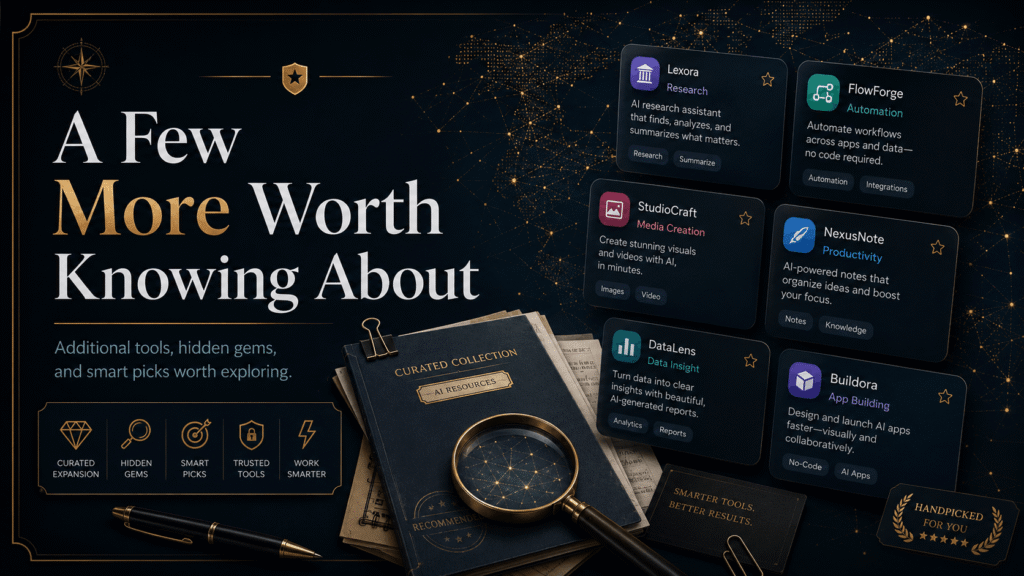
A Few More Worth Knowing About
Beyond the twenty covered above, a handful of additional tools come up constantly in this same genre of discussion and deserve at least a brief mention, since the category keeps expanding faster than any single list can fully capture.
Runway has become a serious option for AI assisted video generation and editing, letting creators generate entirely new video clips from a text description or extend and modify existing footage in ways that used to require specialized visual effects skills.
Suno generates complete, listenable songs, including vocals, from a text description of the style and lyrics, a genuinely strange experience the first time you hear a fully produced track that did not exist five minutes earlier.
Genspark functions as a broader research and content generation agent, capable of pulling together information from multiple sources and assembling it into a structured output, sitting somewhere between a search engine and a research assistant.
Each of these reinforces the same underlying point the main twenty already make. The category is not slowing down, and new entries keep appearing in categories that did not even exist as consumer accessible tools eighteen months ago.
The Debate Worth Having
This is where I want to slow down and actually argue both sides properly, because the fun, breathless tone most articles in this genre use tends to skip past a real question worth taking seriously.
The Case That This Is Genuinely Good News
The strongest argument in favor of this entire trend is that it is straightforwardly democratizing. A small business owner in a smaller market who could never have afforded a professional video editor, a graphic designer, and a research assistant can now access a rough equivalent of all three for a fraction of the cost, often for free. That is not a marginal improvement. It is a meaningful redistribution of capability that used to be gated almost entirely by budget. Independent creators, students, small business owners, and people in regions without easy access to specialized professional services benefit disproportionately from this shift, precisely because the gap these tools close was previously widest for exactly those groups.
There is also a real argument that the fear underneath phrases like feels illegal says more about outdated expectations than about the tools themselves. If a task used to require years of training and now requires a well phrased sentence, that is not automatically evidence of something being wrong. Photography once required a darkroom and real technical skill before digital cameras and editing software made it accessible to anyone with a phone, and very few people today argue photography was somehow devalued by that shift. The same argument applies here.
The Case That This Deserves Some Genuine Caution
The counterargument is not about denying these tools work. It is about being honest that closing an effort gap does not automatically close every gap that mattered. A student using an AI writing assistant to produce a polished essay has not necessarily developed the actual skill the assignment was meant to build, and an employer relying entirely on AI generated visuals and copy without any human judgment applied on top risks producing content that looks competent on the surface but lacks the specific insight or accuracy a real expert would have caught. There is a meaningful difference between a tool that makes a skilled person faster and a tool that lets an unskilled person produce something that merely looks skilled, and conflating the two is where real problems start to appear, whether that shows up as academic integrity concerns, professional work that quietly contains errors nobody caught, or a general erosion of the specific expertise these tools are standing in for.
There is also a fair concern about concentration. As more of this capability consolidates into a smaller number of dominant platforms, the businesses and individuals who become heavily dependent on any single tool are exposed to that tool’s pricing changes, policy changes, or simply going out of business, a real risk given how quickly this space moves and how many similar tools eventually get consolidated, acquired, or shut down entirely.
Where This Actually Lands
The honest synthesis is that both things are true simultaneously. These tools genuinely do redistribute capability in a way that benefits people who previously had the least access to it, and that is a real, meaningful good. At the same time, using them well requires enough underlying judgment to know when the output is actually good, when it needs correction, and when a task genuinely still requires a human expert rather than a fast approximation of one. The businesses and individuals who get the most value out of this entire category are not the ones who use these tools blindly. They are the ones who understand enough about the underlying skill, writing, design, research, code, to use the tool as a genuine accelerant rather than a replacement for their own judgment.
What This Means For Your Business
Stepping back from the individual tools, the practical takeaway for a business owner is straightforward. Adopting tools like these can genuinely save real time and real money across almost every category above, but the businesses that benefit most are the ones that pair these tools with someone who actually understands the underlying work well enough to review the output properly, rather than treating any single tool as a fully autonomous replacement for expertise.
If your business needs help figuring out which of these categories actually apply to your specific operations, and how to build a workflow around them properly rather than adopting tools randomly, that is exactly the kind of strategic conversation our AI automation service is built around. If what you need is the design and content side handled properly, whether that is a rebuilt website, a mobile app, or a full online store, our web development service, app development service, and e commerce website development service combine exactly this kind of AI assisted efficiency with real human review, and you can see genuine examples of that combination in our portfolio.
If your business runs on internal tools and workflows rather than a single customer facing product, our custom software development service covers building the kind of automation described in the coding and business tool categories above, properly architected rather than stitched together from disconnected AI tools. And once your product or service is solid, our digital marketing service helps make sure the right people actually find it.
If you would rather build this understanding internally rather than relying entirely on an outside team, Zynthx Academy runs training programs covering exactly this landscape. Our uses of AI training program gives a grounded, practical overview of tools like the ones described above, while our python programming training program, machine learning training program, and data science training program go considerably deeper for anyone who wants to build rather than just use these tools. Our web development training program and app development training program cover the technical side of turning AI assisted prototypes into real products, and our digital marketing training program and SEO training program cover getting the resulting content and products actually found. Our e commerce website training program rounds out the picture for anyone selling online, and given how much AI generated content and code is now flowing through everyday business tools, our ethical hacking training program is increasingly relevant for making sure none of it introduces security risk nobody caught in time.
If you are further along and want to actually work in this space rather than just adopt tools within it, our careers page lists open roles, with dedicated pages to apply for a job, apply for an internship, or apply as a skills trainer. You can also read more pieces like this one on our blogs page and our dedicated blog section, including our recent post on the best website design trends for businesses in 2026, or contact us directly, and read more about who we are on our about page. You can also follow along on Facebook, Instagram, and LinkedIn for regular updates on tools and trends like the ones covered here. For a fuller look at who we are, our full company overview is available on Slideshare, and you can read verified client feedback on our Bizoforce profile and Yellow Pages UAE listing.
Common Questions
Are these ai websites actually legal to use. Yes, every tool listed above operates within normal, public terms of service, and none of them require anything resembling illegal access or activity. The feels illegal framing is purely about how disproportionately powerful they feel relative to how little effort they require, not an actual legal gray area.
Are these ai websites free to use. Most offer a genuinely useful free tier, though the more advanced features across nearly all of them are usually reserved for a paid plan. The right approach for most people is starting with the free tier to confirm a tool actually fits a real workflow before paying for anything.
Which of these ai websites is best for a small business specifically. It depends entirely on what the business needs most. A business struggling with content creation benefits most from the design and video categories, a business drowning in research or documentation benefits most from the research category, and a business trying to automate repetitive operational work benefits most from the coding and automation category. There is rarely a single best tool across every business, which is exactly why understanding the categories matters more than memorizing a list of names.
Do these ai websites replace the need for human expertise. Not reliably, and treating them that way is where most of the real risk in this category actually sits. They are genuinely excellent accelerants for someone who already understands the underlying work well enough to catch mistakes and apply judgment on top of the output. They are considerably riskier when used as a full replacement for expertise nobody on the team actually has.
How many of these tools should a business actually try to adopt at once. Fewer than you might think. The businesses that get real value out of this category tend to adopt one or two tools properly, integrating them into an actual daily workflow, rather than signing up for a dozen tools and using none of them consistently. Picking the single category above that maps most directly onto a recurring, time consuming task in your business, and mastering that one tool properly, tends to produce far more value than a shallow trial of everything on this list.
Is it worth paying for the premium version of these tools right away. Usually not immediately. Most of the tools above have a free tier generous enough to properly test whether they fit a real workflow before committing to a paid plan. The better approach is running a genuine trial period on the free tier first, confirming the tool earns a place in your actual routine, and only upgrading once that value is clearly proven rather than assumed.
The Honest Closing Thought
The title of this piece, and every article in this genre, leans on a specific feeling, the sense that something this useful should not be this easy to access. I think that feeling is worth taking seriously as a signal rather than dismissing it as just clickbait. It is pointing at something real, that a genuinely large amount of specialized capability has become broadly accessible in a remarkably short window of time, and that shift benefits some people considerably more than others depending on how well they understand what they are actually using.
None of these tools are illegal, and none of them are magic either. What they actually are is a set of genuinely well built accelerants for tasks that used to require real specialized effort, useful for almost anyone, but most valuable in the hands of someone who already understands enough about the underlying work to use the acceleration wisely rather than blindly. That is a less dramatic conclusion than the headline promises, but it happens to be the honest one, and the businesses that internalize it properly are the ones who will get real, lasting value out of this entire category rather than a temporary novelty that fades once the initial excitement wears off.
Let's Start a Project
Share your idea with Zynthx and our team will help you plan the next clear step.
Writer : Haris Waheed
Full Stack Web Developer & SEO Specialist | Building Fast, Search Optimized Websites for Business Growth.


