- +971-50-294-6747
- info@zynthx.tech
- Eiffel Gardens 3, Al Waha Street, Al Quoz 4, Dubai

You Only Have Weeks Left to Vibe Code

Writer : Haris Waheed
Full Stack Web Developer & SEO Specialist | Building Fast, Search Optimized Websites for Business Growth.
Somewhere in the last year, “vibe coding” stopped being a joke and started being a job title. People who had never opened a terminal in their life were suddenly shipping apps, describing what they wanted in plain English, watching an AI model spit out working code, and calling themselves builders. No computer science degree. No bootcamp. Just a prompt box and enough patience to iterate.
It felt like magic, and for a while, it basically was.
But here’s the uncomfortable question nobody wants to ask out loud in the group chats and Twitter threads still celebrating every new “I built this in a weekend” screenshot: what happens when everyone can do it?
Because that’s exactly where we are right now. The numbers back it up: as of January 2026, roughly 90% of developers regularly use at least one AI coding tool at work, up from 85% just months earlier, and adoption keeps accelerating (JetBrains AI Pulse Survey, via Hostinger). What used to be a rare skill is now closer to knowing how to use a spreadsheet than common, expected, and no longer a story worth telling on its own.
If you’ve been riding the vibe-coding wave without thinking about what comes next, you might genuinely have only a few weeks left before the ground shifts under you. Let’s actually dig into that claim instead of just throwing it out as a scary headline. And if you want the short, practical version of everything below, our team at Zynthx Technologies breaks these decisions down with clients every week. You can always book a free consultation to talk through where your own product actually stands.
What "Vibe Coding" Actually Means (For Anyone Just Catching Up)
Vibe coding is the term Andrej Karpathy coined in early 2025 for a pretty simple idea: instead of writing code line by line, you describe what you want “build me a landing page with a signup form and a pricing table” and an AI model generates the code for you. You don’t need to understand loops, functions, or database schemas. You just need to know what you want the thing to feel like, and you keep nudging the AI until it matches the vibe in your head. Karpathy’s own description was blunt: you “fully give in to the vibes… and forget that the code even exists.”
It’s a genuinely useful shift. It lowered the barrier to entry for building software so dramatically that people who spent years feeling locked out of tech designers, marketers, solo founders, curious hobbyists suddenly had a way in. Today, an estimated 63% of active vibe coding users identify as non-developers: product managers, marketing directors, startup founders, and designers, not engineers (Keyhole Software, 2026). Ideas that used to die in a Notion doc because nobody could code them started actually shipping.
That’s the good part, and it’s real. Nobody serious is arguing vibe coding was a scam or a fluke. The tools work. People built things with them real things, with real users.
The question isn’t whether vibe coding worked. It’s whether the specific advantage it gave early adopters is still there.
Why the "Weeks Left" Framing Isn't Just Clickbait
Every hype cycle has a phase where doing the thing itself is the differentiator, and a later phase where doing the thing is table stakes. Vibe coding is sliding from the first phase into the second, and the data shows it’s happening fast.
Think about what made vibe coding feel like a superpower in the first place. It wasn’t really that AI could write code; code generation has existed in some form for years. It was that almost nobody else was using it that way yet. That edge depends entirely on scarcity. And scarcity is exactly what’s disappearing: AI-generated code now makes up somewhere between 41% and 60% of new production code globally, depending on the source, up from roughly 10% in 2023 (13Labs, 2026; Kristian Larsen, 2026). Gartner projects that figure will hit 60% industry-wide by the end of this year alone.
The tools themselves are consolidating too. Cursor passed $2 billion in annual recurring revenue in February 2026. Lovable hit $400 million ARR the same month. The AI coding assistant market, worth $7.37 billion in 2025, is projected to more than quadruple by the early 2030s (13Labs, 2026). When the tools converge and the market consolidates around a handful of dominant platforms, the differentiation moves away from “which tool did you use” and back toward “what do you actually know how to do with it?”
The Argument For: Yes, the Window Really Is Closing
Let’s make the strongest possible case for the urgency in that headline, because it deserves a real argument, not just a vibe (pun intended).
First, the tools are converging and everyone has access. A year ago there was real variance in what different AI coding tools could produce. That gap is shrinking every month. Every major IDE is expected to have native AI code generation within the next 18 months (13Labs, 2026). When the tool stops being rare, it stops being the edge.
Second, the market is getting louder and more crowded. A decent vibe-coded app with a clever idea used to stand out simply by existing. That’s no longer true in most categories, because 25% of Y Combinator’s Winter 2025 batch alone had codebases that were 95%+ AI-generated (Keyhole Software, 2026) — meaning a huge share of the startups you’re competing with for attention were built the same way you built yours.
Third, the debt is coming due and the data on this is genuinely alarming. Independent security testing in 2026 found that AI-generated code contains 1.7 times more major issues than human-written code, including a 2.74 times higher rate of security vulnerabilities (Kristian Larsen, citing Veracode, 2026). A separate audit of five popular vibe coding tools, including Claude Code, Cursor, and Devin, built 15 identical apps and found 69 vulnerabilities, six of them critical (Hashnode, “State of Vibe Coding,” 2026). Roughly 45% of AI-generated code samples fail basic OWASP Top-10 security tests. That’s fine for a weekend project tested by fifty friendly users. It’s a very different problem the moment you have real customer data or real payment flows running through it.
Fourth, even the people who use these tools every day no longer fully trust the output. Trust in AI-generated code accuracy has actually been falling even as adoption climbs, down to roughly 29-33% in 2026 surveys, compared to over 40% just two years earlier (Keyhole Software; Kristian Larsen). And in one of the more startling findings of the year, a controlled study by METR found that experienced open-source developers using AI tools on real, complex codebases were measurably slower than developers not using AI and didn’t realise it. They believed the tools had helped them even after seeing the data (summarised in Hashnode’s “State of Vibe Coding,” 2026).
Fifth, serious partners and investors are asking sharper questions. “I vibe-coded an MVP” used to be an impressive opening line in a pitch meeting. Increasingly, it’s followed by a very specific follow-up: who’s going to maintain this, secure it, and scale it when it actually needs to work under pressure? Forrester expects software development to become the single biggest AI use case in 2026 — but notes only 15% of AI decision-makers have actually reported a profit lift from it so far. A prototype that proves an idea is valuable. A prototype mistaken for a scalable product is a liability.
Put those five things together, and the “weeks left” framing isn’t really about the tools disappearing. It’s about the specific competitive advantage being early, being fast, being one of the few running out of runway. That part is genuinely time-limited.
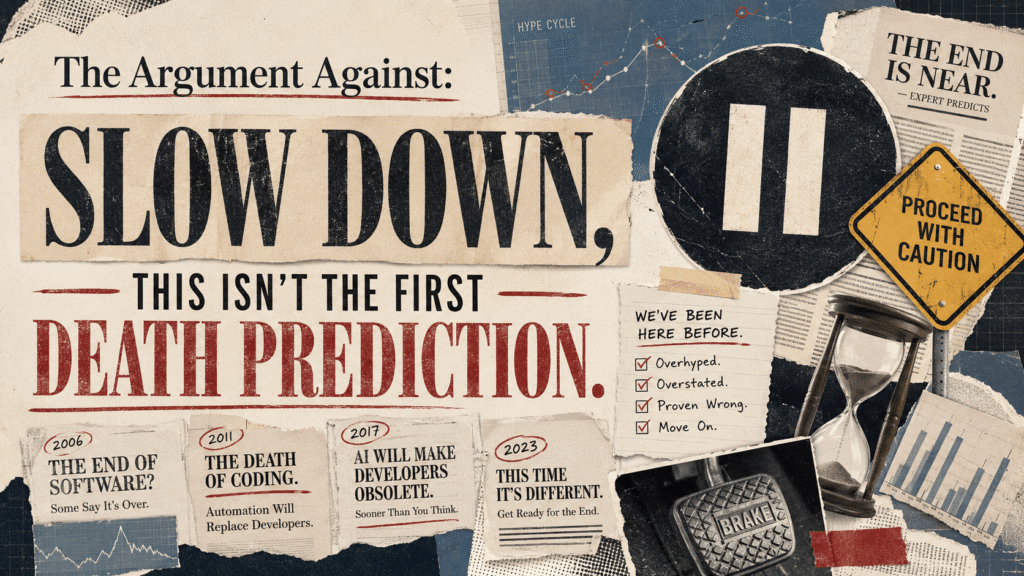
The Argument Against: Slow Down, This Isn't the First Death Prediction
Now let’s steelman the other side, because the tech industry has a long, slightly embarrassing history of declaring things “over” right before they enter their most interesting phase.
No-code tools were supposedly “dead” the moment code-based tools got easier; they weren’t. They just found their lane and stayed there for people who genuinely don’t want to touch code, ever. Vibe coding is likely to follow a similar pattern: not disappear, but settle into being one tool in a much bigger toolbox rather than the whole story.
The claim that “everyone can do it now” overstates how evenly distributed the skill actually is. Interestingly, even among professional developers who use AI tools daily, only around 15% describe their actual workflow as “vibe coding” in the strict sense and 72% say it’s explicitly not part of how they work professionally (CODERCOPS, 2026). Most working developers are doing AI-assisted programming, not the fully hands-off, prompt-and-accept version the term originally described. That distinction matters: the tool being everywhere doesn’t mean the undisciplined version of using it is everywhere too.
There’s also a real argument that vibe coding is only getting started, not ending. The tools are getting more capable at handling exactly the kind of complexity that used to require a developer. Senior developers with 10+ years of experience report the highest productivity gains from AI tools around 81% precisely because they know how to filter bad suggestions before running them (SecondTalent, 2026). If anything, the ceiling on what a well-guided builder can responsibly ship is rising, not falling.
So which is it? Honestly both arguments are correct; they’re just describing different things.
The Real Shift: It's Not Ending, It's Splitting in Two
Here’s where the honest version of this conversation actually lands, and it’s a shift Karpathy himself has already made. In early 2026, he moved past his own term, describing a new phase he calls “agentic engineering” where AI agents handle implementation, but a human still provides architecture, judgment, and review (CODERCOPS, 2026).
Vibe coding as a novelty the ability to say “I built an app” and have that alone be impressive is absolutely on a countdown. That specific flex has an expiration date, and it’s close.
But vibe coding as a legitimate way to build the first version of something isn’t going anywhere. What’s actually splitting apart is what happens after that first version.
One path: you keep vibe coding indefinitely, layering feature on top of feature, prompt on top of prompt, with nobody ever going back to properly architect what’s underneath. This works fine right up until it doesn’t, usually right around the moment real customers start depending on the product working.
The other path: you use vibe coding for exactly what it’s good at: proving the idea, testing the concept, getting something in front of real users fast and cheap and then bring in people who know how to turn that prototype into something that can actually hold weight. Real architecture. Real security review. Real design thinking, not just AI-generated defaults. Real performance work so the thing doesn’t fall over the day it gets traction.
That second path isn’t a failure of vibe coding. It’s the whole point of it.
Where People Get This Wrong
The mistake founders keep making isn’t vibe coding itself; it’s treating the prototype as if it’s already the finished product, just because it technically runs.
The pattern shows up in the open-source world too, and it’s a useful warning sign. Several well-known maintainers have started actively pushing back against low-quality AI-generated contributions flooding their projects. cURL’s maintainer shut down a long-running bug bounty program in early 2026 specifically because AI-generated reports were drowning out real ones, and other projects have started auto-closing external pull requests entirely because maintainers can’t tell real contributions from AI-generated noise fast enough (Hashnode, “State of Vibe Coding,” 2026). That’s not a niche developer complaint; it’s a preview of what happens at scale when speed is optimised indefinitely, past the point where speed stops being the constraint that matters most.
The founders who come out ahead over the next year won’t be the ones who avoided vibe coding. They’ll be the ones who used it exactly where it’s strongest: fast validation, cheap iteration, low-stakes experimentation and then knew exactly when to bring in real expertise to build the version that can actually scale.
What This Actually Means If You're Building Something Right Now
If you’re sitting on a vibe-coded product today, here’s the honest, non-dramatic version of what to think about.
Ask yourself what stage you’re actually at. If you’re still validating whether people want the thing at all, keep vibe coding. Don’t overthink it, don’t hire a development team yet. Speed is still the right priority.
But if people are already using it if you’ve got real signups, real transactions, real dependency on the thing working that’s the signal the window has closed for you specifically, whether or not it’s closed industry-wide. That’s the moment to get someone who actually understands code, security, and scalable architecture to look under the hood.
This is precisely the kind of transition point where a professional development team earns its keep not by replacing what vibe coding got you, but by taking the validated idea and building the version that can actually carry the weight of a real business:
- If your prototype needs to become a real website, our web development service handles exactly this handoff; you can see recent examples of that kind of work in our portfolio.
- If your idea needs to become a proper mobile product with the reliability an App Store listing demands, our app development service covers both iOS and Android builds.
- If what you actually built is closer to an internal tool or a workflow than a customer-facing product, our custom software development service is built for that stage, replacing prompt-generated fragility with software architected around how your business actually runs.
- If you’re selling anything through your vibe-coded prototype, it’s worth a second look through our e-commerce website development service, since payment flows and checkout security are exactly where AI-generated shortcuts tend to hide the most risk.
- And once the product itself is solid, our digital marketing service and AI automation service can help it actually reach people and run efficiently, instead of quietly leaking customers or hours the way most first-draft prototypes do.
If it’s genuinely still early and you just want an honest read on where your project stands, start a project or contact us; there’s no wrong stage to ask the question.
What This Actually Means If You're Building Something Right Now
It’s worth saying plainly: this shift isn’t only a warning for founders. It’s also an opportunity, because the market has started treating vibe coding proficiency as an actual hiring requirement. Companies including Visa, Reddit, and DoorDash now list AI code generator proficiency tools like Cursor and Bolt directly in job postings (Subhrajyoti Mahato, 2026). The people who understand both how to prompt these tools effectively and what’s actually happening under the hood are becoming some of the more employable people in tech right now, precisely because that combination is still rarer than either skill on its own.
If that’s the direction you’d rather take going from “I can prompt an app into existence” to “I actually understand what I built and why it works” that’s exactly the gap our training programs are built to close:
- Web Development Training Program
- App Development Training Program
- Python Programming Training Program
- Machine Learning Training Program
- Data Science Training Program
- Ethical Hacking Training Program, increasingly relevant given how many AI-generated apps ship with unreviewed security holes
- Digital Marketing Training Program and SEO Training Program, for the growth side of the same skill set
- Uses of AI Training Program, if you want the broader picture before specialising.
All of these sit under Zynthx Academy, and if you’re further along and looking to actually work in this space rather than just learn it, our careers page covers open roles, along with dedicated pages to apply for a job, apply for an internship, or apply as a skills trainer if you’d rather teach this shift than just ride it.
So, Do You Really Only Have Weeks Left?
In the narrowest sense, yes. The specific advantage of being an early, novel vibe coder, the “look what I built with just a prompt” moment that used to turn heads on its own, is running out fast. That door really is closing, and it’s closing because the tools that made it special are no longer special. They’re just normal now, used by roughly 9 in 10 developers, generating close to half of all new code written anywhere.
But the broader panic that vibe coding itself is about to become useless or obsolete misses what’s actually happening. It’s not disappearing. It’s maturing into exactly what it should have been from the start: the fastest, cheapest way to test an idea, not a permanent substitute for the deeper technical work a real product eventually needs.
The founders who treat this moment as a deadline to panic about will burn energy trying to out-hype a trend that’s already normalising. The ones who treat it as a signal to get honest about where their product actually stands validated idea or real business, prototype or platform will be the ones still standing in a year, regardless of how many weeks are left on anyone’s countdown clock.
The tool was never really the story. What you build with it, and what you do the moment it starts to matter, always was.
Let's Start a Project
Share your idea with Zynthx and our team will help you plan the next clear step.
Writer : Haris Waheed
Full Stack Web Developer & SEO Specialist | Building Fast, Search Optimized Websites for Business Growth.


