
The Death of Coding Is Cancelled: Why Your AI Assistant Is Quickly Becoming an Imbecile

Writer : Haris Waheed
Full Stack Web Developer & SEO Specialist | Building Fast, Search Optimized Websites for Business Growth.
In Brief
I have two pieces of news, and I want to get them both out of the way immediately rather than burying them. The bad news, coding is not dying, at least not in the way the loudest predictions from the past two years promised. The good news, or the more complicated news depending on how you make a living, is that the reason has nothing to do with sentiment or nostalgia for human craft. It is a specific, well documented, measurable phenomenon researchers have started calling context rot, a predictable degradation in how well an AI coding assistant performs as a task, a conversation, or a codebase grows larger, and it shows up consistently across every major frontier model tested, not just the weaker ones. This article walks through what actually happens during that first brilliant twenty minutes with a new AI coding session, why the following two hours so reliably go sideways, what the real research behind the degradation actually says, and argues honestly about how much of this is a temporary engineering limitation likely to improve, and how much of it reflects something closer to a structural ceiling on what this specific approach to AI can ever reliably do inside a real, growing codebase.
Now, the full story.
Two Pieces Of News
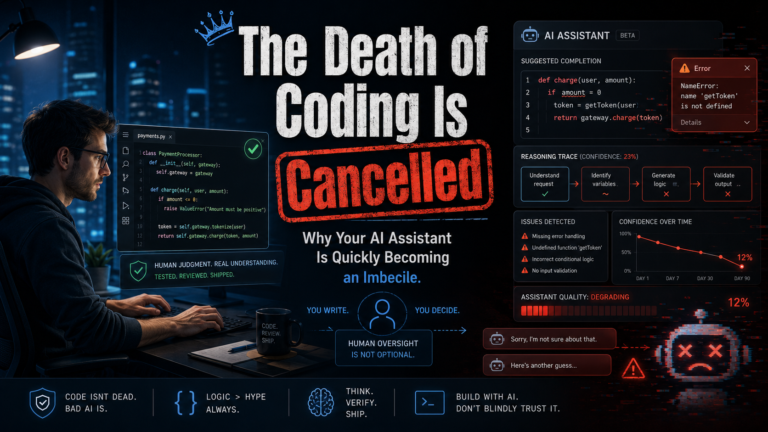
I want to start with the same blunt framing this entire conversation deserves. If you have spent real time working with an AI coding assistant on anything beyond a small, contained task, you have almost certainly already experienced the pattern this article is about, whether or not you had a name for it. You open a new session. The first twenty minutes feel genuinely remarkable, clean code, correct edge case handling, instructions followed precisely. An hour in, something shifts. The suggestions get vaguer. It starts contradicting a decision it made, correctly, thirty minutes earlier. Two hours in, it is confidently writing a duplicate function that already exists three files away, and if you push back or express frustration, the quality does not recover, it gets worse.
That is not your imagination, and it is not a motivational problem you can prompt your way out of by asking the model to try harder or focus more carefully. It is a real, measured, structural phenomenon with a name, and understanding it properly tells you something considerably more useful than either the coding is dead or the coding is totally safe extremes currently dominating the conversation. If you would rather skip straight to talking about how to actually build software well in this environment, our team at Zynthx Technologies works through exactly this kind of AI assisted development every day, and you can start a project or book a free consultation any time.
The Demiurge Phase
There is a specific, almost mythological quality to how a fresh AI coding session feels at the start of a new project, powerful enough that developers genuinely describe it in near godlike terms, a system that seems to conjure a working application out of a single sentence. You describe what you want, hit enter, and the sense of watching something genuinely capable take shape in front of you is real and not exaggerated. For a brand new, cleanly scoped project with a small amount of existing code, this feeling is not an illusion. The model genuinely performs close to its best in exactly this condition, small context, clear instructions, minimal competing information to sort through.
The problem is that almost no real software project stays small, clean, and freshly scoped for very long. Real codebases accumulate history, architectural decisions made for reasons that are not obvious from the code itself, edge cases patched in after a production incident, naming conventions that made sense to the team at the time. That accumulated complexity is exactly the kind of information an AI coding assistant needs to actually understand in order to keep performing at the level it demonstrated in its first twenty minutes, and that is precisely where the entire dynamic breaks down.
What Context Rot Actually Is
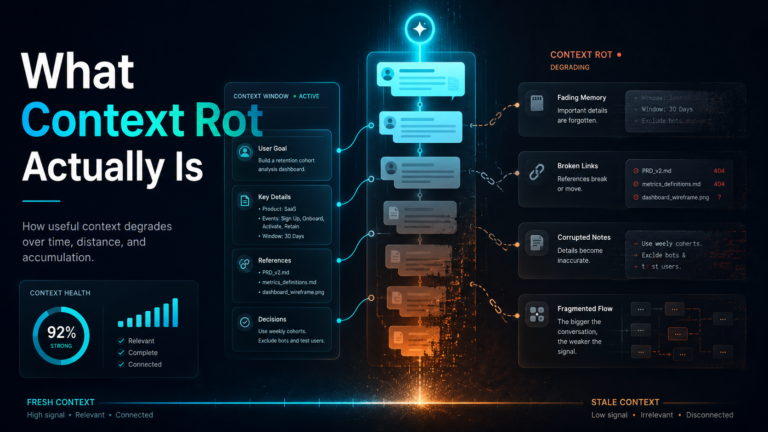
Here is the specific, documented mechanism behind the degradation, and it is worth understanding properly rather than treating it as vague AI unreliability. Researchers at the AI infrastructure company Chroma ran a systematic 2025 study testing eighteen separate frontier language models and found a consistent pattern across every single one, performance degrades, and does so unpredictably, as the length of the input context grows, even well within a model’s advertised maximum context window. The mechanism involves several compounding effects researchers describe as attention dilution and distractor interference, essentially, a model’s ability to correctly weigh and prioritize information does not stay uniform as more information gets added to its working context. Information introduced early in a long session, exactly the kind of foundational detail like your architecture decisions and coding conventions, tends to be the oldest content in that context, and it is consistently the first to lose the model’s effective attention, even though the model has technically not forgotten it in any hard, binary sense.
Birgitta Böckeler, writing for Martin Fowler’s widely respected technical publication in February 2026, distilled the counterintuitive core finding practitioners kept independently discovering on their own, that an agent’s effectiveness actually goes down when it receives too much context, not up, directly contradicting the intuitive assumption that simply feeding a model your entire codebase should make its suggestions more accurate rather than less. The MindStudio research team described the practical shape of this curve plainly, that attention quality degrades with distance, meaning you experience meaningful, real quality loss well before you ever hit a model’s technical context limit, because the degradation is continuous and gradual rather than a hard wall you only encounter at the very edge of the window.
The Real Numbers Behind The Feeling
It is worth grounding this in actual measured data rather than only anecdote, because the numbers are genuinely striking and explain why this feels like such a consistent, widely shared experience across the entire developer community rather than a niche complaint.
GitClear, analyzing more than one hundred fifty million lines of code across real, production codebases, found that AI generated code gets copied and pasted more frequently, gets modified more often shortly after being written, and gets maintained less consistently over time than human written code, a pattern researchers describe as code churn climbing significantly in codebases with heavy AI assistance. That is not a subjective impression. It is a measured pattern across a genuinely enormous sample of real, shipped code, and it points directly at the same underlying issue, code that looked correct in the moment it was generated but did not actually integrate well with the accumulated context and history of the surrounding codebase.
A separate, rigorously controlled study specifically measuring developer productivity found something that directly contradicts the coffee break narrative the source article opens by pushing back against. Experienced developers working on mature, real world codebases were measured at nineteen percent slower when using AI assistance, not faster, a genuinely counterintuitive result given how consistently AI coding tools are marketed around raw speed. At the same time, large scale telemetry across more than ten thousand developers found a ninety eight percent increase in merged pull requests coinciding with a ninety one percent increase in review time, alongside flat overall organizational delivery metrics, meaning the volume of code being produced went up dramatically while the actual pace of shipped, working software barely moved at all. Put plainly, more code was getting written, and more time was being spent catching problems in that code before it could safely ship, a pattern entirely consistent with a tool that is fast at generating plausible looking code and considerably less reliable at generating code that correctly reflects the deeper context of a real, evolving project.
Separately, Qodo’s own developer survey found that nearly one third of all improvement requests developers submitted about their AI coding tools were specifically about making the tool more aware of the existing codebase, team norms, and project structure, a strong, direct signal from the people actually using these tools daily that the core complaint is not raw capability, it is contextual awareness breaking down as a project grows.
Why This Is Architectural, Not Motivational
This is the distinction that matters most for understanding why this problem does not simply get fixed by writing a better prompt or being more patient with the model. Researchers at AscentCore, studying this specific failure mode closely, describe the underlying cause bluntly, that current large language model architectures physically lose reasoning fidelity when submerged in the noise of a large scale codebase, a limitation no amount of prompt engineering alone can fix, because the problem sits in how the underlying model processes information, not in how clearly you happen to phrase your request to it.
This reframes the entire coding assistant conversation in a genuinely important way. The marketing narrative around one million or ten million token context windows implies you can simply paste an entire codebase into a prompt and expect the model to reason perfectly across all of it. Independent research describes this specific expectation as operationally false and, for any team relying on it at scale, genuinely expensive, both in wasted compute and in the downstream cost of catching and correcting the resulting mistakes. Feeding a model your entire two hundred thousand line codebase at once is not thorough context provision. Multiple researchers now describe this practice bluntly as context arson, deliberately burning through a model’s effective reasoning capacity by drowning it in far more information than it can actually weigh correctly at once, even though the raw token count technically fits within the advertised window.
The practical response the field has converged on reinforces this same point from the opposite direction. Teams that are actually solving this problem well are not doing it by waiting for bigger context windows to eventually fix everything. They are doing it through what practitioners now call context engineering, deliberately curating the smallest, highest signal set of information a coding agent actually sees for a given task, using just in time retrieval so the agent requests specific, relevant code only when it genuinely needs it rather than holding an entire codebase in view at once, and treating an AI agent’s context the same way a careful engineer treats any other genuinely scarce, high value resource. That entire discipline exists specifically because the underlying degradation is real, structural, and not something a more patient or more skillfully worded prompt reliably solves on its own.
The Ceiling Nobody Wants To Talk About
Here is where the conversation moves from a practical engineering limitation toward the deeper, more philosophically loaded question the original piece raises directly, whether this specific architecture, a large language model predicting the next token based on patterns learned from training data, can ever scale into something resembling general intelligence capable of reliably handling the full, accumulating complexity of real software development on its own, or whether context rot represents something closer to a genuine structural ceiling rather than a temporary growing pain current research will eventually engineer its way past.
This is a genuinely contested question inside the AI research community itself, not a settled one, and it is worth resisting the pull toward a confident answer in either direction before actually examining the strongest version of each side.

What Serious Researchers Found When They Actually Studied This
It is worth going a level deeper into the specific research that first put a name to this phenomenon, because the findings challenge a lot of the intuitive assumptions teams have quietly built their AI adoption strategies around. In December 2025, researchers at JetBrains presented findings at the NeurIPS Deep Learning for Code workshop that directly challenged the prevailing industry assumption about how to manage context degradation. The common intuition going into that research was that giving a coding agent more surrounding context, more documentation, more related files, more historical detail, should reliably make its output more accurate. The findings complicated that assumption considerably, reinforcing the same counterintuitive pattern independent practitioners kept discovering on their own, that indiscriminately adding more context to an agent’s working memory does not reliably improve output quality and, past a certain point, reliably makes it worse.
This matters beyond the purely technical question of how to configure an AI coding tool correctly, because it is increasingly becoming a genuine governance and compliance issue for larger organizations, not just an engineering inconvenience. The European Union’s AI Act includes high risk provisions taking effect in August 2026, with penalties reaching thirty five million euros or seven percent of a company’s global revenue for serious violations, and those provisions specifically demand documented governance over how AI systems are used in consequential business processes, software development very much included. AI governance committees have become a standard fixture inside mid to large enterprises specifically in response to this regulatory pressure, tasked with maintaining structured oversight over exactly the kind of AI assisted development workflow this article describes. A pattern of degrading, unreliable output that a team cannot fully explain or predict is precisely the kind of gap regulators are now requiring companies to actively identify, document, and manage, rather than quietly working around and hoping nobody asks too many questions about it.
That regulatory backdrop adds real weight to the argument that context rot is not simply an interesting technical curiosity for AI researchers to study. It is becoming a genuine compliance and risk management concern for any organization relying on AI assisted development at real scale, which is exactly why the discipline of context engineering described earlier has moved, in a relatively short period, from a niche best practice shared informally between developers into something increasingly treated as a formal organizational requirement.
The Debate Worth Having
This is exactly the point in the story where the conversation deserves real, honest argument rather than settling for whichever framing is more comforting depending on which side of the coding profession you happen to be standing on.
The Case That Context Rot Is A Temporary Engineering Problem
The strongest version of this argument points out, correctly, that context handling has already improved substantially over a short period, and that the field has a genuinely strong track record of engineering around exactly this kind of limitation once it becomes well understood and well measured. The rise of dedicated context engineering practices, structured retrieval systems, and increasingly sophisticated tools for managing what an AI agent sees and when, are not evidence the problem is unsolvable, proponents argue, they are evidence the field is actively solving it in real time, the same way earlier, equally serious sounding limitations in AI capability have repeatedly given way to targeted engineering solutions once researchers understood the specific mechanism causing them. METR’s own separate research tracking AI task duration found the length of coding task an AI system can reliably complete has been doubling roughly every seven months, climbing from tasks taking about an hour in early 2025 to tasks taking around eight hours by late 2026, a genuinely fast rate of improvement that, if it continues, suggests today’s context limitations may look considerably less severe within another year or two.
The Case That This Reflects A Genuine Structural Limit
The counterargument does not dispute that context handling keeps improving in absolute terms. It challenges whether incremental improvement in how much context a model can technically hold actually addresses the deeper mechanism researchers have identified, that attention quality degrades with distance in a way that appears to be an intrinsic property of how these architectures process information, not simply a capacity limit that scales away once context windows get large enough. The Chroma research specifically found this degradation pattern across all eighteen models tested, including the largest, most capable systems available, which suggests the problem is not primarily about window size at all, since even models with enormous advertised context windows showed the same underlying attention dilution well before reaching their technical limits. On this reading, bigger context windows raise the ceiling on how much information a model can technically hold, but they do not repeal the underlying degradation curve itself, meaning the problem may persist in some form regardless of how large future context windows eventually become, unless a genuinely different architectural approach, not just a bigger version of the current one, addresses the actual mechanism causing the degradation.
Where This Actually Lands
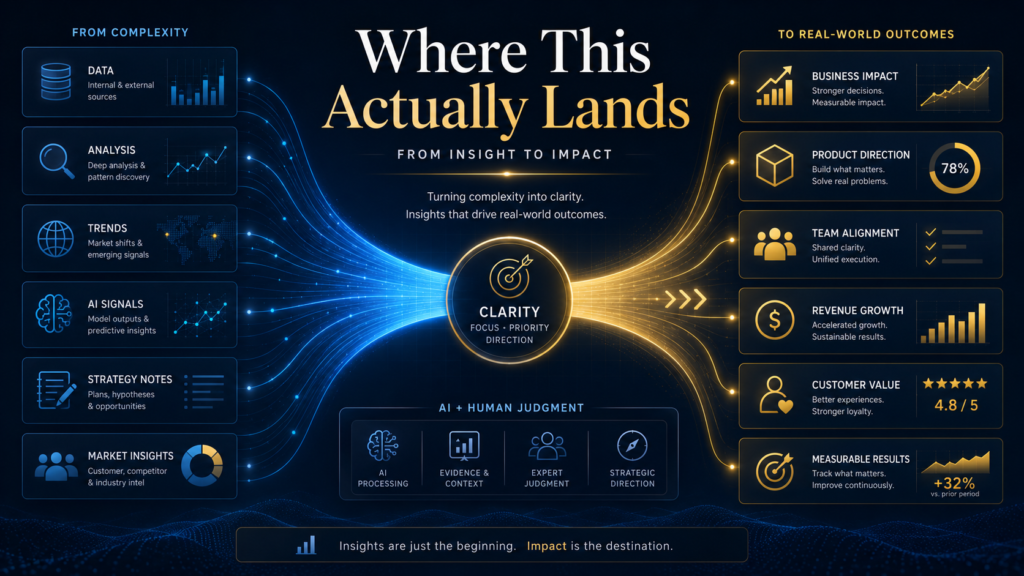
Both readings are held by genuinely serious researchers, and the honest synthesis does not fully resolve toward either side. Real, measurable progress on context handling is happening, and dismissing it entirely would ignore real evidence. At the same time, the fact that the degradation shows up consistently across every frontier model tested, including the most capable ones, is a genuinely strong signal that this is not simply a matter of waiting for the next generation of bigger windows to make the problem disappear on its own. What is not seriously disputed is the practical implication for anyone using these tools right now, that context rot is real, it is measurable, and the current best defense against it is disciplined context engineering by a human who understands the codebase deeply, not blind trust that a bigger window or a more patient prompt will make the underlying issue go away.
What This Actually Means For Your Business
Step outside the research debate for a moment, because there is a genuinely practical lesson here for any business relying on AI assisted development, whether that means an in house team using coding assistants daily or a business evaluating whether AI tools can replace hiring experienced developers entirely. The honest answer, grounded in the actual research above, is that AI coding assistants are a genuinely powerful accelerant for well scoped, clearly bounded tasks, and a considerably less reliable substitute for the kind of deep, accumulated codebase understanding that experienced human developers build over time and that current AI architectures structurally struggle to hold onto as a project grows.
This is exactly the kind of realistic, evidence based approach our team brings to every project. Our web development service, app development service, and custom software development service all use AI assisted development deliberately, in the places it genuinely accelerates good work, with experienced human engineers providing exactly the kind of sustained architectural oversight the research above shows current AI tools cannot reliably provide on their own, and you can see real examples of that balance in our portfolio. If your business needs a properly built AI automation strategy that accounts honestly for where these tools excel and where they need real human review, our AI automation service is built around exactly that kind of clear eyed assessment rather than uncritical hype. If your platform touches customer data or payments specifically, our e commerce website development service is worth a conversation, given how much risk sits in exactly the kind of quietly degraded code this research describes, and once your product is solid, our digital marketing service helps make sure it reaches the right audience.
If you would rather build a genuinely informed team internally, Zynthx Academy runs training built for exactly this kind of grounded technical literacy, including our python programming training program, web development training program, and app development training program for developers who want to understand how to work effectively alongside AI tools rather than blindly trusting their output. Our machine learning training program and data science training program go deeper into how these systems actually work under the hood, our uses of AI training program gives a grounded, practical overview for teams earlier in this journey, and our ethical hacking training program matters as more production code carries the kind of quietly accumulated technical debt this research describes. Our digital marketing training program, SEO training program, and e commerce website training program round out the picture for teams focused on growth once the underlying technical foundation is solid.
If you are further along and want to work in this space directly, our careers page lists open roles, with dedicated pages to apply for a job, apply for an internship, or apply as a skills trainer. You can read more about who we are on our about page, browse more pieces like this one on our blogs page and our dedicated blog section, including our recent post on the best website design trends for businesses in 2026, or simply contact us directly. You can also follow along on Facebook, Instagram, and LinkedIn, see our full company overview on Slideshare, or read verified client feedback on our Bizoforce profile and Yellow Pages UAE listing.
Common Questions
What exactly is context rot in simple terms. It is the measurable, documented tendency of AI language models to produce lower quality, less accurate output as the amount of information in their working context grows, even before they reach their technical maximum context limit, caused by how the underlying architecture weighs and prioritizes information rather than any simple lack of capacity.
Does a bigger context window fix context rot. Only partially. Research testing eighteen separate frontier models found the degradation pattern present across all of them, including models with very large advertised context windows, suggesting a bigger window raises the ceiling on how much information a model can technically hold without necessarily eliminating the underlying attention degradation that happens well before that ceiling is reached.
Does this mean AI coding assistants are not actually useful. No, and that would misread the evidence. They remain genuinely powerful for well scoped, clearly bounded tasks with limited surrounding context, which describes an enormous share of real software work. The research specifically points to a decline in reliability as tasks and codebases grow larger and more complex, not a general lack of usefulness.
Is coding as a profession actually safe from AI replacement. Based on the evidence here, coding that requires deep, accumulated understanding of a large, evolving codebase, exactly the kind of work senior engineers specialize in, remains considerably more resistant to full AI replacement than the more optimistic predictions of the past two years suggested, though this does not mean every part of software development work is equally protected.
What should a development team actually do about context rot right now. The research points toward deliberate context engineering, curating the smallest, most relevant information an AI coding agent needs for a specific task rather than dumping an entire codebase into its context, alongside maintaining strong human oversight for the kind of deep architectural decisions current AI tools structurally struggle to hold onto reliably over time.
The Honest Closing Thought
The title of this piece captures something genuinely true without needing to overstate it. Coding as a profession is not being cancelled by AI, but not because of sentiment, nostalgia, or a comforting story about human creativity being irreplaceable. It is because the specific way today’s AI coding tools actually work carries a real, measured, structural limitation that shows up reliably the moment a task moves beyond a small, cleanly scoped starting point, exactly the moment most real software work actually begins. That limitation might narrow considerably as research continues. It has not disappeared yet, and the evidence suggests it may reflect something closer to a genuine property of the current architecture than a simple capacity problem waiting for a bigger number to solve it.
The businesses and developers who benefit most from this moment will not be the ones who either panicked about coding disappearing or dismissed AI coding tools as a passing fad. They will be the ones who took the actual, documented mechanism seriously, built real practices around managing it, and kept the kind of deep, sustained human understanding of their own codebase that no current AI system has yet demonstrated it can reliably replace on its own.
Let's Start a Project
Share your idea with Zynthx and our team will help you plan the next clear step.
Writer : Haris Waheed
Full Stack Web Developer & SEO Specialist | Building Fast, Search Optimized Websites for Business Growth.


