
OpenAI GPT-5.6: AI Could Do Anything, Then It Met ARC-AGI-3

Writer : Haris Waheed
Full Stack Web Developer & SEO Specialist | Building Fast, Search Optimized Websites for Business Growth.
In Brief
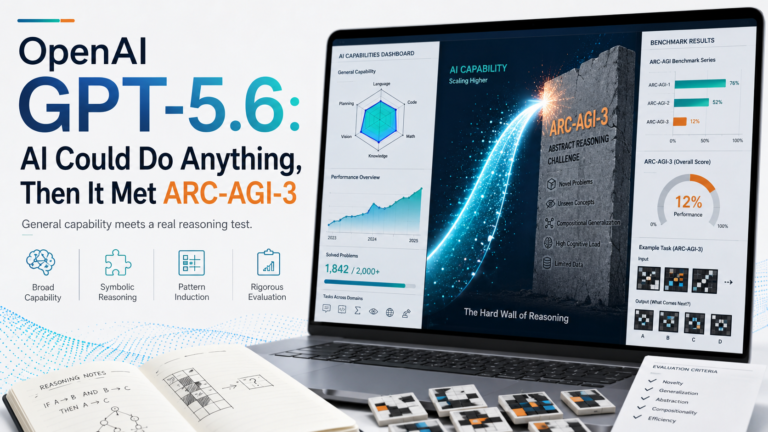
OpenAI released GPT-5.6 in three sizes, Sol, Terra, and Luna, and the launch numbers are genuinely striking, near saturation scores on the older ARC-AGI-1 and ARC-AGI-2 reasoning benchmarks, an OpenAI livestream claim that Sol autonomously post trained the smaller Luna model, and public excitement over the model reportedly working through unsolved mathematical conjectures. Then came the score that undercuts the celebration a little, GPT-5.6 Sol managed just 7.8 percent on ARC-AGI-3, a benchmark specifically designed to be intuitive for humans, who reliably score above 90 percent, and stubbornly difficult for AI. Here is the part that makes the number worth taking seriously rather than mocking, that same 7.8 percent is roughly eighteen times higher than GPT-5.5 managed on the same test just three months earlier, and it makes GPT-5.6 the first verified frontier model to actually solve a full ARC-AGI-3 game. The number is simultaneously a low score by human standards and a genuine leap by AI standards, and untangling which of those two framings actually matters more is where the real, useful debate lives. The rest of this article walks through what ARC-AGI-3 actually tests, why the low score is not the embarrassment it first looks like, and what any of this means if you are trying to figure out how much to actually trust AI capability claims for your own business.
Now, the full story.
There is a very specific kind of whiplash that happens when a company announces a new AI model, and the launch materials read like a highlight reel of things that used to sound like science fiction. That is roughly what happened with GPT-5.6. OpenAI’s own release notes describe a model capable of a step change in design judgment, catching and fixing visual issues in its own generated work before handing it back, and delivering substantial gains in reasoning, decision making, and autonomy for complex professional work. During the launch livestream, OpenAI representatives described the larger Sol variant autonomously post training the smaller Luna model, and separate reporting described the model working through genuinely difficult, previously unsolved mathematical problems. Read only that part of the story and it genuinely sounds like AI can, at this point, do almost anything you throw at it.
Then it met ARC-AGI-3, and the number attached to that specific test tells a considerably more complicated story, one that is worth sitting with properly rather than either dismissing as a footnote or treating as proof the whole capability narrative is fake. If you would rather skip straight to talking about how to think clearly about AI capability claims for your own business decisions, our team at Zynthx Technologies has exactly that conversation with clients regularly, and you can start a project or book a free consultation any time.
What Actually Happened
OpenAI shipped GPT-5.6 in three sizes this month, positioned as its most capable release yet across coding, agentic work, and everyday professional tasks. The headline benchmark numbers back up a lot of that positioning. On the earlier ARC-AGI-1 and ARC-AGI-2 reasoning tests, tests that used to feel genuinely difficult for AI systems not long ago, GPT-5.6 now scores above 90 percent, at a cost per task low enough that independent analysts describe it as setting a new efficiency frontier for the price to performance tradeoff. OpenAI’s own materials emphasize real world professional use cases specifically, describing improvements to subagent coordination that a principal engineer at an asset management firm praised as particularly valuable for complex accounting work, and describing stronger computer use capabilities that let the model inspect and refine its own generated interfaces rather than simply producing code and stopping there.
None of that is exaggerated marketing. Independent commentators who cover this space closely, people who are generally skeptical of hype for a living, have largely confirmed the underlying capability jump is real, particularly on agentic and coding tasks where GPT-5.6 appears to be a genuine, meaningful step forward rather than an incremental update dressed up as one.
The Number Nobody Wanted To Talk About
And then there is ARC-AGI-3, a benchmark created specifically to resist the kind of gaming and memorization that has quietly undermined a lot of older AI benchmarks over the years. It presents a series of simple looking interactive games, the kind of thing that looks almost childish at first glance, colored shapes moving around a small grid, tracks and levers that need to be operated in a specific sequence, puzzles with no instructions attached, where the entire challenge is figuring out the rules of an unfamiliar system through observation and experimentation rather than through pattern matching against something already seen before. Humans, given no explanation whatsoever, reliably score above 90 percent once they play for a few minutes. It is the kind of test almost anyone finds genuinely fun, and genuinely obvious, once they get the hang of it.
GPT-5.6 Sol, the largest of the three released versions and by most measures the single most capable general purpose language model publicly available right now, scored 7.8 percent.
That number is worth sitting with for a moment before rushing to a conclusion in either direction, because both of the obvious reactions, this proves AI is basically fake and this proves nothing at all, miss what is actually interesting about it.
Why That Number Is Both Terrible And Remarkable
Here is the context that makes the number genuinely worth taking seriously rather than treating as a punchline. Three months earlier, GPT-5.5, at the time considered a highly capable model in its own right, managed a score of 0.43 percent on the exact same test, a figure low enough that it barely registers above zero. GPT-5.6 improved on that by roughly eighteenfold in a single generational jump, a rate of improvement that would be considered extraordinary on almost any other benchmark in the industry. For context, Anthropic’s Opus 4.8 model, evaluated separately on the same test, scored 1.5 percent, meaning GPT-5.6 currently holds a meaningful lead over the best publicly reported result from its closest competitor on this specific, notoriously difficult measure of fluid reasoning.
It is also worth being honest about what running this evaluation actually costs, because it undercuts any suggestion that OpenAI is somehow gaming an easy result. The full evaluation at maximum reasoning effort reportedly cost close to twenty thousand dollars to run, a genuinely serious computational expense for a single benchmark pass, which suggests the low score is not a matter of the model being deliberately held back to save money. It is running at real effort and still landing at under eight percent.
So the honest read is this. Relative to a human being who has never seen the test before and figures it out in a few minutes, 7.8 percent is a genuinely poor result. Relative to every other AI model that has ever attempted the same test, including the model’s own immediate predecessor from just months earlier, 7.8 percent is the best result ever recorded, by a wide margin. Both of those statements are true at the same time, and the tension between them is precisely why this specific number deserves more attention than either the triumphant headlines or the mocking ones tend to give it.
Fluid Intelligence Versus Crystallized Intelligence
Understanding why this particular benchmark trips up even the most capable current AI models requires a distinction that shows up throughout cognitive science, the difference between fluid intelligence and crystallized intelligence. Crystallized intelligence is knowledge and skill you have already accumulated, facts, patterns, procedures you have seen before and can apply again in a familiar form. Fluid intelligence is the ability to solve a genuinely novel problem, one you have never encountered in anything resembling this exact form, using reasoning alone, on the spot, often under real uncertainty about what the rules even are.
Modern language models are, almost by design, extraordinarily strong on the crystallized side of that split. They have effectively read an enormous share of human written knowledge, which makes them formidable at tasks that reward pattern recognition against something resembling prior experience, even when that prior experience is spread across millions of documents rather than a single memory. ARC-AGI-3 is specifically engineered to strip that advantage away almost entirely. Every game is built to be unfamiliar, with rules that cannot be inferred from anything resembling a training document, because the entire point of the benchmark is testing whether a system can actually reason its way through a genuinely new situation rather than recognize a variation on something it has effectively seen before.
A useful way to picture the gap involves imagining a completely ordinary but genuinely unfamiliar real world moment, driving down an unfamiliar road at night in unfamiliar weather and suddenly seeing an unclear shape ahead. A person reacts appropriately within a second or two, slowing down, steering around it, without knowing or needing to know exactly what the shape is. That is fluid intelligence in action, reasoning under genuine uncertainty about a situation that does not map cleanly onto anything specifically rehearsed beforehand. AI systems remain considerably weaker at exactly that kind of raw, on the spot reasoning than their fluency in more familiar, previously seen territory would suggest, and ARC-AGI-3 is built specifically to expose that gap as clearly as possible.

How Sol Actually Fails
The genuinely interesting part of this story, and the part most casual coverage skips entirely, is not the final score itself but the detailed breakdown of how GPT-5.6 Sol actually fails at these tasks, because the failure pattern reveals something specific and useful.
According to the evaluation team’s own published analysis, Sol is notably strong at scene comprehension, meaning it reliably figures out what the core mechanics of an unfamiliar game actually are, correctly identifying the rules and relationships governing an environment it has never encountered before, something previous models struggled with considerably more. The evaluators specifically noted that Sol almost always correctly understands what is actually happening in a given puzzle, in some cases correctly working out genuinely complex mechanics, like figuring out that certain game pieces need to be temporarily parked out of the way before a separate mechanism can move freely past them.
Where Sol consistently breaks down is not perception. It is execution, specifically the ability to hold a long, multi step plan together once the required chain of reasoning gets sufficiently deep. The model understands the puzzle. It frequently cannot reliably carry out the full sequence of actions needed to solve it once that sequence gets long enough to require sustained memory and planning across many steps. That distinction matters enormously for how you interpret the low score. A model that fails at perception, that genuinely cannot figure out what is happening in front of it, would suggest a deep limitation in actual reasoning capability. A model that understands the puzzle correctly but loses the thread partway through executing a long plan suggests something closer to a scaffolding and working memory problem, the kind of limitation that has historically responded well to targeted engineering improvements rather than requiring some entirely new breakthrough in the underlying reasoning capability itself.
A Short History Of A Benchmark Built To Keep Moving
To appreciate why ARC-AGI-3 specifically matters, it helps to understand that this is not a single, static test but the third entry in a deliberately evolving series, created by researcher Francois Chollet with an explicit design philosophy behind it, that a genuinely good measure of intelligence should resist being solved through brute memorization or scale alone, and should keep getting harder precisely as AI systems get better at whatever the current version measures.
The original ARC-AGI-1 looked, for a long stretch, like a genuinely difficult wall for AI systems to climb, until the right combination of scale and technique eventually pushed scores toward saturation. ARC-AGI-2 arrived specifically because the first version had started to give way, redesigned to demand a deeper kind of reasoning that the newly capable models of that era still struggled with meaningfully. That version, too, is now scoring above 90 percent for the current generation of frontier models, which is precisely why ARC-AGI-3 exists at all, an interactive, game based evolution built specifically to demand the kind of on the fly reasoning about a genuinely unfamiliar system that static puzzle grids alone no longer reliably tested.
This pattern is worth understanding because it directly shapes how to interpret today’s low score. If history holds, ARC-AGI-3 will likely follow the same arc its predecessors did, appearing nearly impossible for AI systems for a period, then giving way faster than expected once the specific bottleneck holding models back gets identified and addressed. The team behind the benchmark is already reportedly working on a fourth version, anticipating exactly this outcome. That raises a genuinely interesting question worth sitting with rather than resolving too quickly, whether a benchmark that keeps being redesigned specifically to stay one step ahead of AI progress can ever function as a finish line for something as contested as general intelligence, or whether it is better understood as a permanently moving target, valuable precisely because it refuses to be saturated for long, rather than because it will someday declare the question settled once and for all.
The Debate Worth Having
This is exactly where I think the conversation deserves a genuine, honest argument rather than settling for whichever framing is more emotionally satisfying.
The Case That This Proves AI Progress Is Overstated
The strongest version of this argument starts with a fair observation about how AI companies talk about their own progress. OpenAI’s own leadership has, at various points, described artificial general intelligence in terms that shift depending on what is convenient at the time, framing it around economically relevant thresholds like automating a large share of an average office worker’s tasks, or hitting a specific revenue target, rather than any fixed, independently measurable definition of intelligence itself. Critics reasonably point out that redefining the finish line to match wherever the current model happens to be standing is not the same thing as actually reaching genuine general intelligence, and a model that can reportedly help train another model or work through advanced mathematics while still solving fewer than one in ten simple, human intuitive puzzles is a strange kind of intelligence to call general in any meaningful sense of that word.
There is also a fair point about incentive. AI companies are, quite reasonably, incentivized to headline the benchmarks where their models look most impressive and say considerably less about the ones where the gap to human performance remains enormous. A model industry that consistently promotes 90 percent plus scores on older, increasingly saturated reasoning benchmarks while staying comparatively quiet about single digit scores on the benchmark specifically designed to resist that kind of saturation deserves at least some skepticism about how representative the headline numbers actually are of genuine, general capability.
The Case That This Is A Genuine, Underappreciated Breakthrough
The counterargument does not deny any of the numbers above. It reframes what they actually mean. An eighteenfold improvement in a single generational model jump, on a benchmark specifically engineered to resist exactly the kind of shortcut that usually drives fast benchmark gains, is a genuinely rare rate of progress, and treating it as unimpressive purely because the absolute number remains low relative to human performance ignores how difficult this specific category of test has proven to move at all historically. Earlier versions of the same benchmark, ARC-AGI-1 and ARC-AGI-2, both looked similarly resistant to AI progress for extended stretches before eventually being pushed toward saturation once the right combination of scale and technique arrived, and the same pattern could plausibly repeat here.
The detailed failure analysis genuinely supports a more optimistic reading too. A model failing specifically at long chain execution and planning, while succeeding reliably at correctly understanding a genuinely novel environment, is failing at a problem with a reasonably well understood engineering path forward, better working memory, better plan tracking across long sequences, rather than at the much harder, much less well understood problem of building genuine reasoning about unfamiliar situations from scratch. Being the first verified model to solve even a single full ARC-AGI-3 game at all, something no previous model had managed regardless of score, is a genuine qualitative milestone that a raw percentage score understates on its own.
Where This Actually Lands
Both readings are defensible, and I do not think the evidence currently available forces a confident choice between them. What is fair to say is that the gap between headline AI capability claims and performance on a benchmark specifically designed to test genuine, unfamiliar situation reasoning remains real and worth tracking closely, and that dismissing either the low absolute score or the striking rate of improvement in isolation misses the more interesting and more honest story sitting in the middle of both numbers.
What This Actually Means For Your Business
Step outside the philosophical debate for a moment, because there is a genuinely practical lesson here regardless of which side of the AGI argument you find more convincing. The gap this benchmark reveals, strong performance on familiar, well represented tasks and considerably weaker performance on genuinely novel, unfamiliar situations, maps almost directly onto how AI tools actually perform inside a real business today. A model like GPT-5.6 is, by all available evidence, genuinely excellent at coding, drafting, research, and other tasks with enormous amounts of prior example material to draw on. It remains considerably less reliable the moment a task looks nothing like anything it has effectively seen before, which is exactly the kind of situation a growing business runs into constantly, a genuinely unusual customer request, an edge case nobody anticipated, a decision that depends on context no training data could have captured.
That distinction is exactly why the businesses getting the most real value out of AI tools right now are the ones who understand where the fluid versus crystallized line actually sits for their specific workflows, rather than assuming a model that aces a coding benchmark will handle every unfamiliar situation with the same reliability. This is precisely the kind of practical assessment our AI automation service is built around, figuring out which parts of your operation genuinely benefit from AI automation today and which parts still need a human in the loop specifically because they involve the kind of genuine novelty these benchmarks are designed to expose.
If what you actually need is a properly built product on top of whichever AI capability makes sense for your business, our web development service, app development service, and custom software development service all handle that build with a realistic understanding of where AI genuinely helps and where a human still needs to own the decision, and you can see real examples of that work in our portfolio. If your business sells online and is thinking about how much of the customer experience to hand to AI versus keep human led, our e commerce website development service is worth a conversation, and once your product is solid, our digital marketing service helps make sure it reaches the right audience.
If you would rather build this understanding on your own team, Zynthx Academy runs training built for exactly this kind of clear eyed thinking about AI capability, including our uses of AI training program for a grounded overview, and our machine learning training program and data science training program for teams who want to understand these systems at a deeper level rather than taking a benchmark headline at face value. Our python programming training program covers the practical building side, our web development training program and app development training program cover turning that understanding into a shipped product, and our ethical hacking training program matters increasingly as more business logic gets handed to systems that, as this entire article demonstrates, can fail unpredictably outside familiar territory. Our digital marketing training program, SEO training program, and e commerce website training program round out the picture for teams focused on growth rather than infrastructure specifically.
If you are further along and want to work in this space directly, our careers page lists open roles, with dedicated pages to apply for a job, apply for an internship, or apply as a skills trainer. You can read more about who we are on our about page, browse more pieces like this one on our blogs page and our dedicated blog section, including our recent post on the best website design trends for businesses in 2026, or simply contact us directly. You can also follow along on Facebook, Instagram, and LinkedIn, see our full company overview on Slideshare, or read verified client feedback on our Bizoforce profile and Yellow Pages UAE listing.
Common Questions
What is ARC-AGI-3 actually testing. It is a set of interactive puzzle games designed to be intuitive and solvable for humans within minutes, without any instructions, while remaining specifically resistant to the kind of pattern matching that lets AI models perform well on many other benchmarks. It is meant to isolate fluid, on the spot reasoning about genuinely unfamiliar situations rather than testing recall of familiar patterns.
Does a 7.8 percent score mean GPT-5.6 is not actually that capable. Not in any simple sense. GPT-5.6 remains, by most independent assessments, extremely capable at coding, agentic work, and professional tasks with strong benchmark support elsewhere. The low ARC-AGI-3 score specifically reveals a gap in handling genuinely novel situations rather than undermining its documented strengths in more familiar territory.
Is this evidence that artificial general intelligence is close or far away. It genuinely depends on which definition of intelligence you are using, and this is exactly why the debate in this article does not resolve to a clean answer. Under a definition focused on economically useful task completion, GPT-5.6 already looks remarkably capable. Under a definition focused on general, fluid reasoning about unfamiliar situations, a single digit score on a benchmark humans solve intuitively suggests real intelligence, in that specific sense, remains genuinely distant.
Will ARC-AGI-3 eventually get saturated the way the earlier versions did. Historically, that has been the pattern for this benchmark series, with each version looking nearly impossible for a period before AI progress caught up faster than expected once the specific bottleneck was understood. Whether the same pattern repeats here is a genuinely open question rather than a settled prediction, and a fourth version of the benchmark is already reportedly in development specifically in anticipation of that possibility.
What should a business actually watch for as future models are released. Rather than tracking a single headline benchmark number, it is worth paying attention to how a new model performs specifically on tasks that resemble your own genuinely unfamiliar edge cases, since strong performance on widely publicized benchmarks does not reliably predict strong performance on the kind of novel situation a specific business actually encounters day to day.
Should a business trust AI more or less because of this result. Neither blindly. The specific lesson is that AI tools are highly reliable within familiar, well represented territory and considerably less reliable the moment a task looks genuinely novel, and a responsible AI adoption strategy accounts for that gap explicitly rather than assuming uniform reliability across every kind of task a business might throw at it.
The Honest Closing Thought
The most useful way to hold this story is neither the triumphant version nor the dismissive one. GPT-5.6 genuinely is a remarkable model by nearly every conventional measure the AI industry currently uses, and it genuinely does still fail, badly, at a benchmark specifically designed to catch exactly the kind of reasoning gap that raw benchmark dominance can otherwise hide. Both of those facts are true at the same time, and they are not actually in tension with each other once you understand what each measurement is actually testing.
What the detailed failure analysis suggests, a model that understands unfamiliar situations correctly but struggles to execute long plans built on top of that understanding, is a genuinely useful signal for anyone trying to figure out how much to trust a capability claim rather than just how impressed to be by it. The businesses and individuals who benefit most from tools like GPT-5.6 over the next year will not be the ones who took either the highlight reel or the scandal headline at face value. They will be the ones who understood, specifically, where the reliable territory actually ends, and built their expectations, and their workflows, around that boundary rather than around whichever framing happened to trend that week.
Let's Start a Project
Share your idea with Zynthx and our team will help you plan the next clear step.
Writer : Haris Waheed
Full Stack Web Developer & SEO Specialist | Building Fast, Search Optimized Websites for Business Growth.


