
Everyone Blames AI for Oracle Layoffs, But Here Is The Truth

Writer : Haris Waheed
Full Stack Web Developer & SEO Specialist | Building Fast, Search Optimized Websites for Business Growth.
In Brief
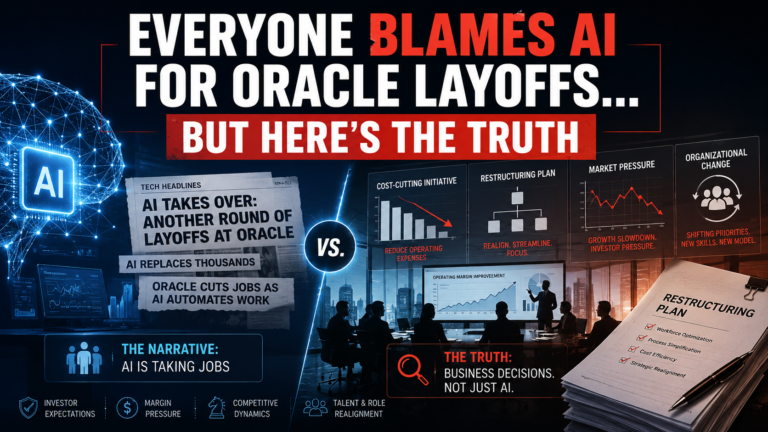
On the morning of March 31, 2026, tens of thousands of Oracle employees opened a short, cold email informing them their role had just been eliminated, with system access cut off almost immediately after. By the time the dust settled, Oracle had cut roughly 30,000 jobs globally, including approximately 12,000 in India, in what analysts are calling the largest layoff in the company’s 48 year history. The instant, almost reflexive explanation that spread across social media and casual commentary was simple, ai did this, robots are finally taking real jobs, even senior ones. That explanation is not entirely wrong, but it is also not the real story, or at least not the whole of it. The fuller picture involves a company carrying heavy debt from a difficult acquisition, a struggling government contract, and a genuinely enormous financial bet on AI infrastructure that required freeing up capital from somewhere, with headcount being the somewhere Oracle chose. This article walks through what actually happened, why the easy ai explanation is too simple, what the real financial pressures actually were, and argues honestly about how much blame ai genuinely deserves in a story that is really about corporate strategy wearing an ai shaped mask.
Now, the full story.
I am going to say one thing plainly before going any further. Ai is not what got thirty thousand people fired at Oracle this year. That is what nearly everyone assumed the moment the headlines broke, because it is the simplest, most viral explanation available, and it fits a narrative that has been building across the tech industry for the past two years. It sounds logical. It sounds scary. And if you accept it without digging further, you are going to walk away with a genuinely wrong picture of what actually happened inside one of the largest layoffs in recent tech history.
If you would rather skip straight to talking through how ai adoption actually affects staffing decisions at your own business, rather than the headline version, our team at Zynthx Technologies has exactly this conversation with clients regularly, and you can start a project or book a free consultation any time.
What Actually Happened
Let me walk through the actual sequence of events first, because the details matter considerably more than the headline. On the morning of March 31, 2026, thousands of Oracle employees across the United States, India, Canada, and Mexico received a short, five line email from Oracle Leadership informing them their role had been eliminated, effective that same day. There was no prior warning, no call from a manager, and no conversation beforehand. Access to internal systems was cut off almost immediately after the email landed. Within hours, LinkedIn, Reddit’s r slash employeesOfOracle, and the professional forum Blind were flooded with posts from affected employees trying to piece together what had actually happened and why.
By the time the full picture emerged, reporting converged on a consistent figure, roughly 30,000 jobs cut globally, with approximately 12,000 of those in India, representing something close to forty percent of Oracle’s Indian workforce at the time. The cuts were not confined to a single product line or a single level of seniority. Reports pointed to significant reductions across Revenue and Health Sciences, Oracle’s SaaS and Virtual Operations Services division, the NetSuite India Development Centre, and cloud and enterprise engineering teams more broadly, with each of the two hardest hit divisions losing somewhere around thirty percent of their staff. And critically, this was not limited to junior roles. Senior managers, directors, and engineers with fifteen to twenty five years of experience were let go alongside far more junior colleagues, in some cases just months after being promoted.
One particularly telling detail came directly from inside the company. Michael Shepherd, a senior Oracle manager, stated publicly on LinkedIn that the layoffs were, in his words, not performance based, confirming that high performers and recently promoted employees were cut right alongside everyone else. That single detail matters enormously for understanding what actually happened, because it directly undercuts the simplest version of the ai replaced them narrative, the idea that specific employees were let go because an ai system had become capable enough to specifically replace their individual output. If that were genuinely the driving logic, you would expect the cuts to track fairly closely with which roles were most automatable, not to sweep broadly across seniority levels and performance tiers in a way that looked, by multiple internal accounts, closer to a company wide capital reallocation than a targeted, role by role automation decision.
The Easy Story Everyone Told
Here is why the ai explanation spread as fast and as widely as it did, and it is worth understanding honestly rather than dismissing as pure gullibility. The tech industry has spent the past two years watching a genuinely real trend unfold, companies publicly citing ai efficiency gains as a reason for reduced headcount needs in specific functions, and prominent voices in the industry have been vocal about it. Shaadi.com founder Anupam Mittal captured the broader sentiment well when he pointed out publicly that today’s layoffs look meaningfully different from the layoffs of past economic downturns, because companies like Oracle are not cutting jobs due to weak business performance. Oracle’s own numbers back that up directly, with cloud revenue crossing fifty two percent of total revenue for the first time in the same quarter the layoffs were announced, alongside genuinely strong overall financial results. Mittal’s framing was specific and fair, that companies are restructuring not because they need to survive but because ai increasingly lets them operate certain functions with meaningfully fewer people than before.
That framing is not wrong as a broad industry trend. It is simply incomplete as an explanation for this specific, unusually large, unusually senior heavy round of cuts at this specific company, in this specific moment, and treating it as the complete explanation obscures several other factors that, once you actually look at Oracle’s financial situation, appear to have mattered considerably more directly to the size and shape of this particular layoff.
The Real Financial Picture
Oracle’s own financial results tell a story that is genuinely more complicated than either pure ai disruption or pure business weakness. The company’s cloud revenue was, as mentioned, growing strongly, and analysts covering the company were broadly describing it as accelerating rather than retreating. That combination, strong growth alongside a historic wave of layoffs, is exactly the kind of pattern that should make anyone pause before accepting a simple explanation, because a company that is genuinely struggling and a company that is aggressively reallocating capital toward a specific strategic bet can produce headlines that look superficially similar from the outside while reflecting completely different underlying realities.
The reality in Oracle’s case leans heavily toward the second explanation. The company has committed itself to an extraordinarily large, extraordinarily expensive bet on AI infrastructure, including a significant partnership with OpenAI and a role in the five hundred billion dollar Stargate AI infrastructure project alongside SoftBank. Building and operating the physical infrastructure, the data centers, the specialized chips, the power contracts, required to support commitments at that scale requires an enormous amount of capital, capital that has to come from somewhere inside a company’s existing budget, and headcount costs are consistently one of the largest, most flexible line items any large company has available to reallocate quickly when a strategic bet of this size needs funding.
The Cerner Problem Nobody Talks About
Here is the part of the story that gets mentioned far less often than it should, because it does not fit neatly into either the ai narrative or the pure infrastructure investment narrative, and it deserves genuine attention on its own. In 2022, Oracle acquired Cerner, a major electronic health records company, for twenty eight point three billion dollars, one of the largest acquisitions in the company’s history. Integrating a company that size into Oracle’s existing operations is never simple, and by multiple independent reports, the Cerner integration had become a genuine source of financial strain by early 2026, with the healthcare unit reportedly hit hardest by the layoffs of any single division across the entire company.
Adding to that pressure, Oracle had also run into specific difficulties with a major contract tied to the US Department of Veterans Affairs, a project connected to the same broader Cerner healthcare technology push, which reportedly added further financial pressure on top of the acquisition costs themselves. None of this made major headlines the way the ai story did, largely because a struggling multi year technology integration project and a difficult government contract are simply less exciting, less shareable stories than robots are taking your job, even when the underlying financial impact was, by most independent accounts, considerably more directly responsible for the size and severity of this specific round of cuts.
The AI Spending Connection That Is Real
None of this means ai has nothing to do with what happened, and it would be dishonest to swing too far in the opposite direction and claim ai played no role at all. The connection is real, but it works differently than the simple version of the story suggests. Ai did not directly replace the specific senior engineers and managers who lost their jobs in the sense of an algorithm literally performing their exact previous role. What ai did was create an enormous, genuinely urgent capital demand, the infrastructure buildout described above, that competed directly against existing headcount costs for a limited pool of available capital, at a moment when Oracle was simultaneously carrying the weight of the Cerner integration and a difficult government contract.
Put plainly, the honest version of the story is not ai replaced these workers. It is closer to ai infrastructure investment demanded so much capital, so quickly, that a company already under financial strain from other commitments chose to fund it partly by reducing headcount broadly across seniority levels and functions, rather than by specifically automating the roles being cut. That is a meaningfully different story than the viral version, and it matters because it points toward a completely different set of lessons for anyone trying to understand what these layoffs actually predict about the future of their own job or their own business, a subject worth taking seriously rather than reducing to a single scary word.
Why The Layoffs Were Not Performance Based
It is worth returning to Michael Shepherd’s public statement, because it is one of the most useful, most underexamined pieces of evidence in this entire story. If ai capability genuinely drove these specific cuts in the direct, role by role sense the popular narrative implies, you would expect the pattern of who got cut to track reasonably closely with which specific tasks or roles had become most automatable. Instead, the reporting consistently describes a broad, cross functional sweep, hitting senior managers with decades of experience, recently promoted employees, and high performers essentially interchangeably with everyone else in the affected divisions.
That pattern is far more consistent with a capital reallocation decision, a company deciding it needs to reduce a fixed cost, total headcount expense, by a specific percentage across specific divisions to free up capital for a specific strategic priority, than with a targeted automation decision made role by role based on which specific jobs ai could now perform. The WARN Act filing associated with these layoffs, which confirmed separations expected through June 1, 2026, and industry reporting on the required sixty day notice period for mass layoffs at qualifying sites, further reinforces that this was handled as a large scale, centrally coordinated restructuring event rather than a rolling series of individual role eliminations tied to specific automation milestones being hit team by team.
The Severance Controversy That Added To The Anger
Beyond the core question of what caused the layoffs, a second controversy unfolded almost immediately afterward that shaped public perception nearly as much as the layoffs themselves, and it is worth understanding because it reveals something about how the cuts were actually executed rather than just why. In India specifically, affected employees were reportedly offered a severance package consisting of fifteen days of base salary for each year of service, payment for unused leave, an ex gratia payment of fifteen days per year of service plus two additional months of salary, one month of paid gardening leave, and a fixed insurance contribution, adding up to an estimated three to three and a half months of salary depending on tenure. That is a meaningfully smaller package than what Oracle reportedly offered departing employees in other markets, and considerably smaller than packages other major tech companies had offered in their own layoffs earlier the same year.
A specific condition attached to that Indian severance package generated particular anger once it became public. Some affected employees reported that the full ex gratia amount was only paid out if the departure was formally labeled a voluntary resignation rather than a layoff, a distinction with real consequences for how the departure appears on an employee’s record and for certain legal protections tied to involuntary termination. In the United States, separately, a WARN Act filing confirmed that separations were expected to be completed by June 1, 2026, and industry observers noted that if Oracle had skipped the sixty day advance notice period the WARN Act requires for mass layoffs at qualifying sites, affected employees might be legally owed sixty days of back pay in addition to whatever severance they ultimately received, a question that remained a live point of dispute among affected workers and labor attorneys in the weeks following the layoffs.
None of this severance controversy directly answers the question of what caused the layoffs, but it matters for understanding why the anger and the search for a clear villain, ai being the simplest available one, spread as fast and as intensely as it did. A layoff executed this abruptly, with this little advance communication, and with a severance structure some employees experienced as coercive, was always going to generate a strong emotional response, and a clean, simple explanation like ai did this is a considerably easier story to process and share than a more accurate account involving acquisition debt, contract trouble, and a multi hundred billion dollar infrastructure bet made by executives the affected employees never spoke to directly.
The Debate Worth Having
This is exactly the point in the story where the conversation deserves real, honest argument rather than settling for whichever framing spread furthest on social media.
The Case That AI Really Is The Underlying Cause
The strongest version of this argument does not require ai to have directly automated any specific role to still be the real underlying cause. It points out that without the enormous capital demands of the AI infrastructure buildout, Oracle would likely not have needed to free up capital at this scale in the first place, regardless of how the Cerner integration or the VA contract were going independently. On this view, ai is not a minor contributing factor sitting alongside the real causes, it is the actual root cause that created the financial pressure everything else got layered on top of, and describing the Cerner acquisition or the government contract as more important risks missing the forest for the trees. The infrastructure spending was a choice Oracle made specifically because of the competitive pressure created by the broader ai race, and every other financial strain the company was managing simply made that already difficult choice even harder to fund without cutting headcount.
The Case That This Is Financial Restructuring Wearing An AI Costume
The counterargument does not deny that ai infrastructure spending was real and significant. It challenges the idea that ai deserves to be described as the cause in any meaningful, specific sense, as opposed to being one of several genuine financial pressures that happened to coincide at the same moment. Companies have run large, painful restructurings tied to acquisition integration problems and difficult government contracts for decades, long before ai infrastructure spending existed as a category at all, and attributing this specific layoff primarily to ai risks giving the actual, more mundane and more common causes, acquisition overreach, contract trouble, straightforward cost discipline, considerably less scrutiny than they deserve, simply because ai makes for a more compelling headline than a healthcare acquisition integration going over budget.
There is also a fair point about incentive on Oracle’s own side worth naming honestly. A company undergoing a difficult, senior heavy layoff driven partly by acquisition strain and contract trouble has a genuine public relations incentive to let the ai narrative dominate the conversation rather than correct it forcefully, since ai driven restructuring reads, in the current media environment, as a forward looking, strategically savvy story rather than a story about a twenty eight billion dollar acquisition not integrating as smoothly as planned.
Where This Actually Lands
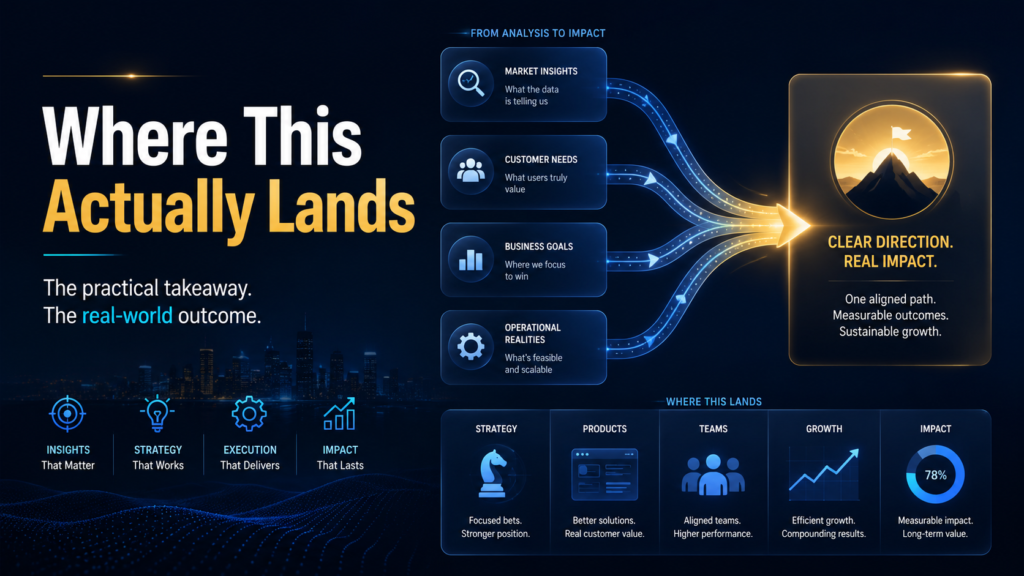
The honest synthesis does not fully side with either framing. Ai infrastructure spending was a real, significant, and probably necessary contributing pressure, not a minor footnote. The Cerner integration strain and the VA contract trouble were also real, significant, and probably underweighted contributing pressures in most of the public conversation about this event. Both things were true at the same time, layered on top of each other, and reducing the entire story to a single cause, whichever cause happens to generate the most engagement on social media, genuinely distorts what actually happened inside a company managing several serious financial pressures simultaneously rather than responding to just one.
What This Actually Means For Your Business
Step outside the Oracle story specifically and there is a genuinely useful, transferable lesson here for any business owner trying to think clearly about ai and staffing rather than reacting to whichever headline crosses their feed. The Oracle layoffs are not solid evidence that ai has become capable enough to directly replace senior, experienced professionals at scale, and treating them that way risks either unwarranted panic about your own team’s job security or, on the flip side, an unwarranted assumption that aggressive headcount cuts are now a safe, ai justified strategic move regardless of your company’s actual underlying financial position.
What the Oracle story actually demonstrates is that large scale ai infrastructure investment creates genuine, significant financial pressure that competes directly against other budget priorities, headcount very much included, and that pressure compounds considerably when it lands on a company already managing other financial strain. For a smaller business considering its own AI investment, the practical lesson is to go in with clear eyes about what that investment actually competes against in your specific budget, rather than assuming AI adoption is either a costless efficiency win or an inevitable job destroyer. This is exactly the kind of grounded, honest assessment our AI automation service is built around, helping a business understand realistically what AI investment actually costs, what it actually saves, and where the tradeoffs genuinely sit for your specific situation rather than the version of the story that happens to be trending.
If what your business actually needs is a properly built product or platform that puts ai capability to real, sustainable use without the kind of financial overreach that contributed to Oracle’s situation, our web development service, app development service, and custom software development service all handle that build with a realistic, sustainable approach, and you can see real examples of that work in our portfolio. If your business sells online, our e commerce website development service is worth a look for how AI genuinely fits into that specific customer experience, and once your product is solid, our digital marketing service helps make sure it reaches the right audience.
If you would rather build a genuinely informed team internally rather than reacting to headlines, Zynthx Academy runs training built for exactly this kind of clear eyed thinking, including our uses of AI training program for a grounded, practical overview, and our machine learning training program and data science training program for teams who want to genuinely understand what these systems can and cannot realistically do for their business rather than reacting to viral headlines about mass layoffs. Our python programming training program covers the practical building side, our web development training program and app development training program cover turning that understanding into a real, sustainable product, and our ethical hacking training program matters as more business critical infrastructure depends on AI systems that need proper security review. Our digital marketing training program, SEO training program, and e commerce website training program round out the picture for teams focused on growth rather than infrastructure specifically.
If you are further along and want to work in this space directly, our careers page lists open roles, with dedicated pages to apply for a job, apply for an internship, or apply as a skills trainer. You can read more about who we are on our about page, browse more pieces like this one on our blogs page and our dedicated blog section, including our recent post on the best website design trends for businesses in 2026, or simply contact us directly. You can also follow along on Facebook, Instagram, and LinkedIn, see our full company overview on Slideshare, or read verified client feedback on our Bizoforce profile and Yellow Pages UAE listing.
Common Questions
Did AI actually replace the specific employees Oracle laid off. By most available evidence, not in any direct, role by role sense. The cuts swept broadly across seniority levels and performance tiers, including recently promoted and high performing employees, a pattern more consistent with broad capital reallocation than targeted automation of specific job functions.
How many people did Oracle actually lay off, and where. Reporting converges on roughly 30,000 jobs cut globally, with approximately 12,000 of those in India, representing close to forty percent of Oracle’s workforce in the country at the time, alongside significant cuts in the United States, Canada, and Mexico.
What actually caused the layoffs if it was not simply AI. A combination of factors, most significantly the enormous capital demands of Oracle’s AI infrastructure buildout, including its role in the Stargate project, layered on top of financial strain from the twenty eight point three billion dollar Cerner acquisition and reported trouble with a major Veterans Affairs contract, all landing at the same time.
Is Oracle’s situation a sign that AI is now capable of replacing senior professionals broadly. Not based on the specific evidence from this case. The layoffs read more clearly as a financial and strategic capital reallocation decision than as evidence that AI systems have become capable of directly performing the work of experienced senior managers and engineers at the scale the headlines implied.
Should other companies expect similar AI infrastructure driven layoffs. Possibly, for companies making similarly large infrastructure commitments while simultaneously managing other financial strain, but the Oracle case specifically involved an unusual combination of factors, a historically large acquisition integration and contract trouble, that will not apply equally to every company investing in AI infrastructure, making broad generalization from this single case risky.
The Honest Closing Thought
The instinct to blame ai for a headline making layoff this large is understandable, and it is not entirely wrong either, since the AI infrastructure spending genuinely was a real and significant pressure on Oracle’s finances. But treating it as the whole story flattens a genuinely more interesting, more useful account of what actually happened, one involving a difficult acquisition, a struggling government contract, and a company making a very large, very expensive strategic bet all at the same time, with headcount serving as one of the levers available to fund that bet rather than as evidence of AI directly performing the jobs of the people who lost them.
The businesses and individuals who benefit most from stories like this one are the ones who resist the pull of the simplest, most viral explanation and actually look at what a company’s own financial situation says about what really happened. Ai is reshaping how companies think about headcount, genuinely and significantly, but it is doing so as one pressure among several, not as a simple, standalone villain in every layoff headline that mentions it. Understanding that distinction properly is worth considerably more than accepting whichever version of the story happened to spread fastest.
Let's Start a Project
Share your idea with Zynthx and our team will help you plan the next clear step.
Writer : Haris Waheed
Full Stack Web Developer & SEO Specialist | Building Fast, Search Optimized Websites for Business Growth.


