
Claude Code Just Released a Feature That Genuinely Scares Me (And I Use AI Every Day)

Writer : Haris Waheed
Full Stack Web Developer & SEO Specialist | Building Fast, Search Optimized Websites for Business Growth.
In Brief
Claude Code, Anthropic’s agentic coding tool, recently shipped background agents that can complete an entire coding task on their own, then commit the code, push it, and open a draft pull request without waiting for a human to approve anything first. Alongside that, Anthropic introduced Dynamic Workflows, capable of coordinating up to a thousand subagents on a single complex task. After two years of using AI daily, this is the first Claude Code feature that genuinely gave me pause, not because it is reckless, but because it is capable enough that its independence actually matters. The rest of this article walks through why that reaction made sense, why the guardrails Anthropic built in address most of the concern, and then makes the full evidence based case for why Claude Code has pulled ahead of Cursor, GitHub Copilot, and every other AI coding tool on the market in 2026, along with a fair look at where those competitors still win.
Now, the full story.
I have used artificial intelligence tools every single day for the past two years. I have watched autocomplete turn into full conversations, watched chatbots turn into agents, and watched agents turn into something closer to coworkers. Very little about this space surprises me anymore. I say that as someone who genuinely thought I had built up a tolerance for the pace of change in this industry.
Then Claude Code shipped a feature that made me stop typing for a full minute and just stare at my terminal.
It was not a flashy announcement. There was no keynote moment, no viral demo video, no dramatic countdown timer. It showed up quietly in a changelog entry, the kind most people scroll past without reading closely. But once I understood what it actually meant in practice, I could not stop thinking about it. And the more I sat with it, the more I realized the feeling I was having was not really fear of the technology itself. It was something closer to respect mixed with a very reasonable amount of caution, the same feeling you get the first time you hand someone the keys to something that actually matters.
Let me walk you through what happened, why it unsettled me, and why, after thinking about it properly, I still believe Claude Code is the strongest AI coding tool available today. Both things can be true at once, and honestly, I think they should be. If you would rather skip straight to talking about what a tool like this could actually do for your own business, our team at Zynthx Technologies works with agentic AI tools like this regularly, and you can start a project or book a free consultation any time.
The Feature That Stopped Me Cold
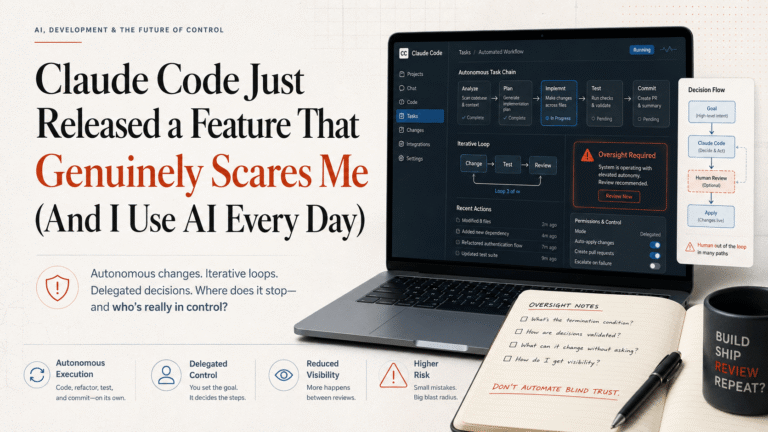
Here is the plain version. Claude Code now runs background agents that can work entirely on their own inside an isolated development branch called a worktree. You give the agent a task, close your laptop if you want, and walk away. When the agent finishes the work, it does not wait for you to review anything first. It commits the code, pushes it to the repository, and opens a draft pull request by itself. No pause. No confirmation prompt. No moment where it stops and asks whether this is really what you wanted.
Read that again, because the significance is easy to skim past. For years, every AI coding tool on the market has operated with a simple, comforting rule built into its design. The AI proposes. The human disposes. You could let a model draft an entire function, but somewhere along the way, a human was expected to look at the diff and click accept. That single click was the last checkpoint, the final human decision before code entered the world. It was the seatbelt.
Claude Code’s background agents remove that seatbelt for an entire category of work. They plan the task, execute every step, run the necessary commands, and ship the result as a real, reviewable artifact sitting in your repository, waiting for a code review that has not happened yet by a person who has not seen the code yet.
To make this even more concrete, Anthropic also introduced what it calls Dynamic Workflows, a system capable of coordinating up to a thousand subagents working on a single complex task at the same time. A thousand. Not ten, not fifty. A coordinated swarm of AI workers, each handling a piece of a larger problem, reporting back into a structure that assembles their output into something coherent. When I first read that number, my instinct was almost physical. It felt like the kind of scale that used to belong exclusively to distributed systems engineering, not to a single developer typing a request into a terminal window on a Tuesday afternoon.
Why This Actually Scared Me
I want to be precise about what worried me, because I think vague nervousness about AI is not useful and often says more about unfamiliarity than about the technology itself. My concern was specific, and it broke down into three separate pieces once I actually sat down and examined it properly.
The first issue is trust calibration. Humans are notoriously bad at knowing when to trust automated systems appropriately. We either trust them too little, checking every single output obsessively and losing the entire point of automation, or we trust them too much, letting the system run unattended long after it has earned that level of confidence. A background agent that commits and opens a pull request without asking is designed for the second kind of user, the one who has learned to trust it. That is exactly the kind of workflow where a small mistake, made quietly and repeatedly, can accumulate into a real problem before anyone notices.
The second issue is scale. One unattended agent making an occasional mistake is manageable. A thousand coordinated subagents working simultaneously across a codebase multiply that risk in a way that is genuinely hard to reason about intuitively. If even a small percentage of subagent decisions introduce a subtle bug, a security gap, or a violation of some unstated architectural rule, you now have that error propagated across a much larger surface area, and it happened while nobody was watching in real time.
The third issue is psychological, and I think it is the most honest one. Watching an AI system open a pull request under its own authority, using your credentials, acting as though it were a member of your team, forces a genuine reckoning with what autonomy actually means. It is one thing to say, in the abstract, that AI agents will eventually act independently. It is another thing entirely to see a notification appear informing you that a piece of software just made a decision on your behalf and already told your team about it.
So yes, that feature scared me. I think it should give any serious engineer a moment of pause. But fear, when it is this specific, is usually pointing at something worth examining closely rather than something worth avoiding entirely. So I examined it.

Why The Fear Does Not Mean The Feature Is Wrong
Once I got past the initial reaction, I noticed something important. Anthropic did not ship this feature carelessly. Background agents operate inside scoped permissions. You can restrict exactly which file paths an agent is allowed to touch, block specific tools from being used at all, and set an agent to read only mode where it can analyze code but never modify anything. Permission prompts that used to be silently denied when an agent ran in the background now surface properly in the main session instead of failing invisibly, which is a meaningful safety improvement introduced specifically because Anthropic was paying attention to exactly the risk I described above.
The draft pull request step also matters more than it first appears. The agent does not merge its own code into production. It opens a draft, a clearly marked, unmerged proposal sitting in the queue for a human reviewer. The seatbelt was not removed entirely. It moved. Instead of sitting at the moment of writing code, it now sits at the moment of merging code, which arguably is where it always should have been for serious engineering work in the first place.
And there is a deeper truth underneath all of this. Software teams have used automated systems that act without asking permission for a long time already. Continuous integration pipelines deploy code automatically once tests pass. Dependency bots open pull requests to update packages without a human requesting each one individually. Monitoring systems restart failing services without waking anyone up first. The idea of software acting autonomously within defined boundaries is not new. What changed with Claude Code is the intelligence of the thing acting, not the fact that something is acting without asking. That distinction, once I sat with it, moved my feeling from alarm toward something closer to informed respect.
The Debate Worth Having
This is where I want to shift from the personal reaction to the professional argument, because the feature itself opened up a bigger question I think deserves an honest, evidence based answer. With Cursor, GitHub Copilot, OpenAI Codex, and several newer entrants all competing for the same developers, is Claude Code actually the strongest choice, or is this just recency bias talking because it happens to be the one that startled me this week.
I went looking for the actual evidence, and the case for Claude Code turns out to be considerably stronger than a single dramatic feature.
The Benchmark Case
On SWE bench Verified, widely regarded as the most rigorous public test of whether an AI system can resolve real, unmodified issues taken from actual GitHub repositories rather than toy coding puzzles, Claude’s models have consistently posted the highest scores among the major coding tools. Anthropic’s own published benchmark sheet puts its newer Opus model close to 88 percent on that test, alongside a strong result on the harder, multi language SWE bench Pro variant, both ahead of the comparable OpenAI model results tracked in the same reporting. GitHub Copilot Workspace has been measured around 55 percent on the same benchmark, and Cursor’s own last published score sat closer to 48 percent. That is not a marginal gap. It is the difference between a tool that can occasionally resolve a real production bug and one that can do it reliably enough to build a workflow around, which is exactly the kind of reliability that made the autonomous background agent feature possible in the first place.
The Architecture Case
Cursor is, at its core, a very well designed editor with AI woven deeply into it. GitHub Copilot is, at its core, an extension layered onto whichever editor you already use. Claude Code took a different path entirely. It was built terminal first, as a genuinely agentic system that plans a task, executes shell commands, edits files across an entire codebase, runs tests, and iterates on failures, all without needing you to open an editor at all. Multiple independent comparisons published this year describe Cursor’s agent capabilities as real but noticeably less autonomous than Claude Code’s, closer to a highly capable assisted editor than a fully agentic system. Claude Code, by contrast, is consistently described as the tool developers reach for specifically when they want maximum autonomy on a complex, multi step task, the kind of work where you genuinely want to hand something off rather than sit and supervise every line.
The Adoption Case
Numbers rarely lie as cleanly as marketing copy does, and the adoption numbers here are striking. According to the JetBrains Developer Ecosystem Survey conducted in January 2026 across more than ten thousand professional developers, Claude Code usage grew from roughly 3 percent in April 2025 to 18 percent in January 2026, a sixfold increase in nine months, which several industry analysts have called the fastest adoption curve any developer tool has ever recorded. Perhaps more telling than the raw growth number is who is driving it. When JetBrains asked developers with more than ten years of professional experience which AI coding tool they would choose for daily work, 46 percent picked Claude Code, compared to single digit percentages for the older, more established tools. Senior engineers, the people with the most experience judging whether a tool actually holds up under real pressure, are choosing Claude Code at a rate no competitor comes close to matching. Run rate revenue for Claude Code reportedly crossed two and a half billion dollars within roughly a year of launch, an unusually fast trajectory for a professional developer tool
The Example That Made It Click For Me
Numbers are convincing, but a concrete comparison is what actually settled the question for me personally. A recent hands on test built the same application, a small web project with authentication, search, and pagination, using Cursor, GitHub Copilot, and Claude Code separately, starting from an identical template with an identical scope. Cursor finished in about five and a half hours with strong visual feedback for every change. GitHub Copilot finished in six hours, carried largely by strong autocomplete on repetitive boilerplate. Claude Code finished the same task in four and a half hours, and the meaningful difference was not typing speed. It was that Claude Code’s agent handled the entire multi step sequence, creating the data model, running the migration, scaffolding the views, and writing the tests, from a single prompt, autonomously, while the other tools still expected a human to direct each individual step along the way. The final code quality across all three was roughly comparable. The difference was how much of the actual thinking and sequencing the tool was trusted to handle on its own, which is precisely the capability that makes the background agent feature possible in the first place.
Being Honest About Where Claude Code Does Not Win
A fair argument has to include the counterpoints, and there are real ones. GitHub Copilot remains the most accessible option by a wide margin, with the lowest price point, the broadest editor compatibility, and the deepest integration into existing GitHub based workflows for teams that live and breathe issues and pull requests. If your organization has already standardized on GitHub Enterprise, Copilot is often simply the path of least resistance, and its productivity gains for that specific context are real and well documented.
Cursor, meanwhile, still leads on pure day to day editing experience. Its autocomplete engine posts strong acceptance rates, its visual diff based workflow gives developers a satisfying sense of control over every change, and for engineers who want to see and approve each modification as it happens rather than delegate an entire task, Cursor remains genuinely excellent. Multiple surveys this year found that most experienced developers do not pick a single tool and stop there. They use two or three tools together, commonly pairing Copilot or Cursor for fast, moment to moment editing with Claude Code specifically for the heavier, more autonomous work. That pattern itself is a form of evidence. Developers are not treating Claude Code as a replacement for everything else. They are treating it as the tool they reach for when a task is complex enough that they actually want to hand it off completely, which says something meaningful about where its particular strength lies.
So the honest conclusion is not that Claude Code wins every category. It is that Claude Code has become the clear leader specifically in the category that matters most for where software development is heading, genuine autonomous reasoning across a real, messy, imperfect codebase, and that leadership is exactly why it was capable of shipping a feature confident enough to make an experienced daily user pause and reconsider what autonomy actually means.
What This Means If You Run A Business
Stepping outside the developer conversation for a moment, this shift matters even if you never personally write a line of code. If the tools your development team or your outsourced technical partner relies on are becoming genuinely autonomous, the questions you should be asking as a business owner are changing too. It is no longer only about whether a tool writes good code. It is about what that tool is authorized to do on its own, who reviews what it produces, and how quickly your team can catch a mistake before it reaches customers.
This is exactly the kind of shift where working with a development partner that actually understands agentic AI tools, rather than treating them as a novelty, makes a real difference. If your business needs a website or platform built with this new generation of tools, our web development service and app development service teams use exactly this kind of technology responsibly, with proper review built into every stage. You can see real examples of that work in our portfolio, and read more about our approach on our about page.
If what you actually need is internal software built around your specific workflows rather than a customer facing product, our custom software development service is built for that, and if security is a growing concern as more of your stack becomes AI generated, that concern is well placed. A tool capable of writing and shipping code on its own is also a tool that needs proper security review built around it, which is precisely what our ethical hacking training program at Zynthx Academy covers. Alongside that, our web development training program, app development training program, python programming training program, machine learning training program, and data science training program all give teams the underlying technical understanding needed to actually supervise agentic tools like Claude Code properly, rather than trusting them blindly or avoiding them entirely.
If you are selling products online and thinking about how AI generated code touches your payment flows specifically, our e commerce website development service is worth a look, since checkout and payment logic is exactly where AI generated shortcuts tend to hide the most risk. And once your product itself is solid, our digital marketing service and its companion digital marketing training program and SEO training program help make sure it actually reaches people, alongside our e commerce website training program and uses of AI training program for teams who want the fuller picture of how these tools fit together.
There is also a wider opportunity hiding inside all of this that most businesses have not fully grasped yet. If a coding agent can be trusted to complete an entire task and hand it off for review, the same underlying pattern, an AI system doing real, multi step work autonomously and surfacing the result for a human to approve, applies far beyond writing code. It applies to customer support, lead follow up, internal reporting, inventory management, and dozens of other repetitive business processes that currently eat up staff hours every single week. This is exactly the shift our AI automation service is built around, taking the same agentic principles that make Claude Code capable of shipping a pull request on its own and applying them responsibly to the parts of your business that are still done manually today. The businesses that understand this pattern early, rather than treating Claude Code as purely a developer tool, are the ones who will find the most value in this entire generation of agentic AI.

The Bigger Picture: Where Agentic Coding Is Actually Headed
It is worth stepping back and asking where this trend goes next, because the background agent feature is unlikely to be the last checkpoint that quietly disappears. Anthropic has been fairly open about its broader direction, describing a future where developers spend less time writing individual lines of code and more time defining what needs to be built, reviewing what came back, and making the judgment calls that still genuinely require a person. Other major players in the space are converging on a similar vision, even if they are moving at different speeds. OpenAI’s Codex and various emerging agentic frameworks are all racing toward the same basic idea, systems that can hold an entire task in mind, execute it across multiple steps, and only surface for human input at meaningful decision points rather than after every single action.
What makes Claude Code’s current position notable is not that it invented this direction. It is that the benchmark data, the adoption numbers, and the real world build comparisons all suggest it got there first, and got there with guardrails that were actually thought through rather than bolted on after the fact. That combination, being early and being careful at the same time, is genuinely rare in a field that usually rewards speed over caution. Whether that lead holds depends heavily on how competitors respond over the next year, and it would be naive to assume no other company will close that gap. But for right now, in the middle of 2026, the evidence points in one direction fairly clearly.
There is also a quieter shift worth naming, because it changes what skill actually matters going forward. As agentic tools take over more of the mechanical work of writing code, the developers who thrive will not necessarily be the ones who type the fastest or memorize the most syntax. They will be the ones who are good at defining a task clearly, anticipating what could go wrong, and reviewing a large, complex change quickly and accurately. That is a different skill set than traditional programming, closer to technical leadership than hands on coding, and it is a skill set that is currently in short supply relative to how fast the tools demanding it are advancing.
If you are further along and want to work in this space directly, our careers page lists open roles, with dedicated pages to apply for a job, apply for an internship, or apply as a skills trainer. And if you simply want to talk through what any of this means for your specific business, contact us directly, or browse more pieces like this one on our blogs page and our dedicated blog section, including our recent post on the best website design trends for businesses in 2026. You can also follow along on Facebook, Instagram, and LinkedIn for regular updates on how tools like this are actually changing the work we do for clients.
Common Questions
What exactly did Claude Code release that caused this reaction. Background agents that can complete a coding task entirely on their own, then commit, push, and open a draft pull request without waiting for a human to review anything first, alongside Dynamic Workflows, which can coordinate up to a thousand subagents on a single complex task.
Is Claude Code actually safe to use this way. The background agent feature includes scoped permissions, the ability to restrict which files an agent can touch, a read only mode, and the fact that agents open a draft pull request rather than merging directly into production. The human checkpoint moved from the moment of writing code to the moment of merging it, rather than disappearing entirely.
Is Claude Code really better than Cursor and GitHub Copilot. On the specific benchmark that matters most, resolving real world coding issues autonomously, yes, by a meaningful margin. On day to day editing experience and price accessibility, Cursor and Copilot still have real strengths, which is why most experienced developers use more than one tool rather than relying on a single one exclusively.
Should a business be worried about AI writing code without review. The realistic concern is not the AI itself but how much oversight a team builds around it. A background agent that opens a draft pull request still requires a human to review and merge it, so the actual risk sits in whether that review step is taken seriously, not in the existence of the automation itself.
How is Claude Code different from a simple autocomplete tool. Autocomplete suggests the next few lines of code as you type, and you accept or reject each suggestion individually. Claude Code operates at a completely different level, taking a full task description, planning the necessary steps, executing commands in a terminal, editing multiple files across a codebase, running tests, and iterating on failures, all without needing constant line by line direction. The background agent feature extends that same autonomy even further by removing the need for a human to be present at all while the work happens.
Does using Claude Code mean a business needs fewer developers. Not necessarily, and the honest answer depends heavily on how a team chooses to use it. Some teams use tools like this to take on more ambitious projects with the same headcount rather than shrinking the team, since the mechanical parts of implementation get faster while the judgment heavy parts, deciding what to build and reviewing what came back, still require the same experienced people as before. Other teams do reduce reliance on junior level implementation work as agentic tools handle more of it directly. Which outcome applies to a given business depends on its specific goals and how it chooses to redeploy the time these tools free up.
What I Actually Think Now
I keep coming back to a simple realization. The feature scared me precisely because it worked. A background agent opening a pull request without asking is only unsettling if you trust the underlying reasoning enough to worry it might act on something you have not personally verified yet. Nobody feels nervous about a system they consider unreliable. You just ignore an unreliable system. You only feel that particular flavor of unease around something capable enough that its independence actually matters.
That is where I have landed. The fear was real, and I do not think it was irrational. But it was fear of capability, not fear of failure, and those are very different things to sit with. Used carelessly, with permissions left wide open and pull requests merged without review, this feature could absolutely cause real damage. Used the way it was clearly designed to be used, with scoped permissions, draft pull requests as a genuine checkpoint, and a human still making the final merge decision, it represents something closer to a preview of where competent engineering teams are actually headed. Less time spent on the mechanical parts of writing code. More time spent on the judgment calls that still require an actual human, deciding what should be built, reviewing what came back, and drawing the boundaries around how much autonomy a system has earned.
I am not fully at ease with it yet, and I do not think I am supposed to be. But I would rather sit with that discomfort honestly than pretend the tools around me have not changed. Claude Code did not scare me because it is dangerous in some careless, poorly built way. It scared me because it is good enough that the old assumption, that a human always looks before code ships, is no longer automatically true. That is a genuinely significant moment in how software gets built, and pretending otherwise would be its own kind of denial. If your business is trying to figure out how to use tools like Claude Code well rather than either avoiding them out of caution or adopting them without proper oversight, that is precisely the conversation we have with clients every week, and it starts with a simple free consultation.
Let's Start a Project
Share your idea with Zynthx and our team will help you plan the next clear step.
Writer : Haris Waheed
Full Stack Web Developer & SEO Specialist | Building Fast, Search Optimized Websites for Business Growth.


